AI may be a software revolution, but its most stubborn bottleneck is physical: electricity. A model can be copied in seconds; a transmission line, transformer or power plant takes years. That mismatch has turned a formerly sleepy corner of the dividend market—utilities and electrical infrastructure—into one of 2026’s most consequential investment themes.
The opportunity is real, but “AI exposure” is not a substitute for analysis. Some beneficiaries carry heavy debt, some trade at growth-stock valuations, and some must spend billions before regulators allow them to earn a return. This guide separates the durable cash-flow beneficiaries from the fashionable labels.
The number that changes the utility investment case
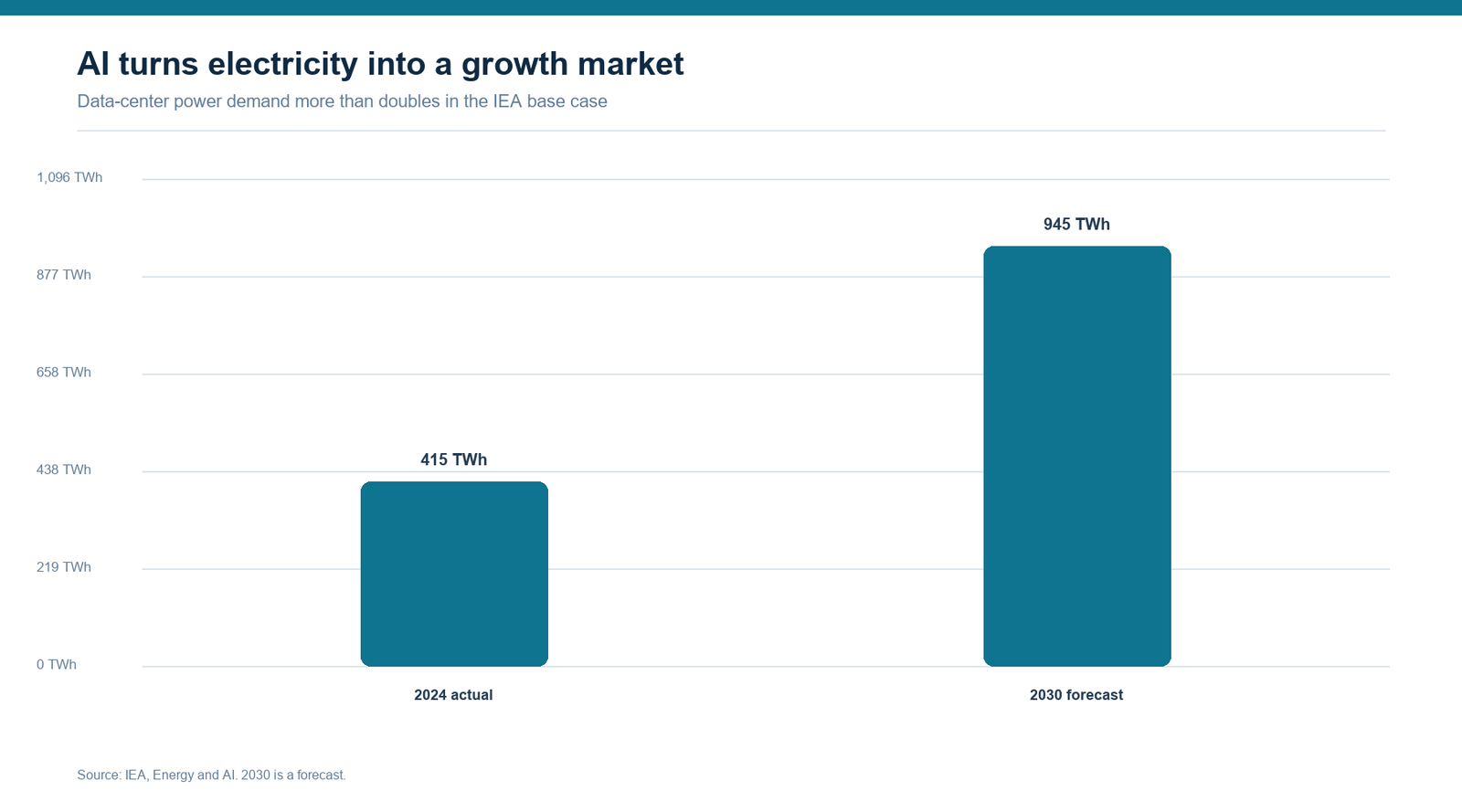
The International Energy Agency estimates that data centers consumed about 415 TWh globally in 2024 and could consume roughly 945 TWh by 2030. In the US, data centers are expected to account for about half of electricity-demand growth through 2030. That is not a one-quarter catalyst; it is a multi-year capital cycle.
There are four ways a dividend investor can approach it: regulated utilities that add assets to their rate base; equipment manufacturers selling transformers, switchgear and backup power; data-center landlords; and energy producers with dispatchable generation. Each has a different risk profile.
Our 2026 watchlist
| Company | Role in the theme | Dividend case | Main risk |
|---|---|---|---|
| NextEra Energy (NEE) | Regulated utility and renewables | Long dividend-growth culture | Financing cost and execution |
| Duke Energy (DUK) | Large regulated service territories | Visible rate-base investment | Regulatory pushback |
| Southern Co. (SO) | Southeastern electricity demand | Established income profile | Valuation and project costs |
| Eaton (ETN) | Switchgear and power management | Dividend growth plus secular growth | Low starting yield, rich multiple |
| Cummins (CMI) | Backup and distributed generation | Industrial cash flow and dividend | Cyclical end markets |
| Digital Realty (DLR) | Data-center real estate | REIT income with AI demand | Debt, capex and tenant concentration |
How to rank them instead of chasing a story
1. Contracted demand beats a press release
Look for signed service agreements, backlog and identified capital plans—not vague references to AI. Utilities still need regulator approval and cost recovery. Equipment suppliers need orders that convert to revenue without destroying margins.
2. Test dividend coverage after capital expenditure
A payout can look safe against accounting earnings while free cash flow is deeply negative because of construction. For utilities, examine funds from operations, financing needs, rate-base growth and credit ratings together. Our guide to avoiding dividend traps explains why yield alone is the wrong starting point.
3. Separate compounders from income stocks
Eaton may offer a lower yield but faster earnings growth. Duke or Southern may provide more immediate income but slower growth. The correct comparison is expected total return and dividend durability, not which number in the yield column is largest. Investors building cash flow should also compare the approach with our dividend ETF guide.
What could break the thesis?
- Grid delays: projects can sit in interconnection queues for years.
- Ratepayer backlash: households may resist paying for infrastructure serving hyperscalers.
- Technology efficiency: better chips and models may reduce power per unit of computation.
- Overvaluation: a sound business can still be a poor investment at the wrong price.
- Debt refinancing: utilities and REITs are unusually sensitive to the cost of capital.
Bottom line
The best AI dividend investment may not manufacture a chip. It may own the regulated wires, transformers, backup systems or buildings that make the chip useful. We favor a basket approach: one regulated utility, one electrical-equipment compounder and—only for investors comfortable with leverage—one data-center REIT. Review this alongside our REIT ETF analysis and portfolio-building guide.
Investment decision dashboard
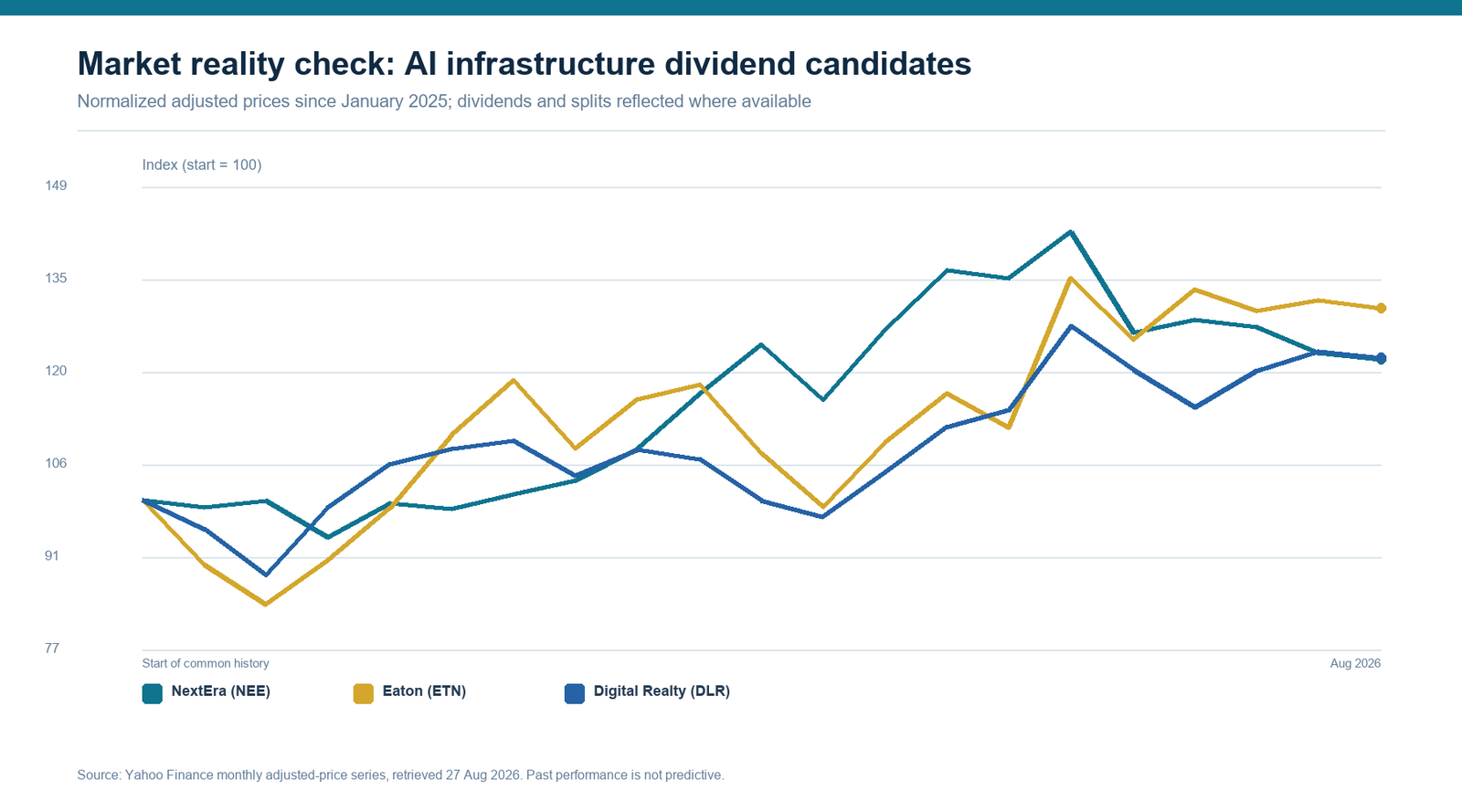
The two charts answer different questions. The demand chart establishes the economic tailwind; the market chart shows that investors have already recognized parts of it. That is crucial: a strong industry forecast does not automatically imply an undervalued stock.
Editorial view: Treat AI electricity demand as a screening theme, then make the final decision using regulated returns, backlog conversion, balance-sheet capacity and valuation. We would not buy any candidate solely because management mentioned data centers.
What would change our ranking?
A signed hyperscaler agreement with transparent cost recovery would improve a utility’s score. A credit downgrade, equity issuance required merely to fund the dividend, or capex growth without matching earnings visibility would reduce it. For equipment suppliers, rising backlog matters only if pricing and margins survive the capacity expansion.
Review quarterly results using the same checklist each time: contracted megawatts, capex, allowed return, free cash flow, net debt and forward payout coverage. That turns a fashionable narrative into a repeatable research process.
Sources and methodology
Theme data: IEA Energy and AI and IEA Electricity 2026. Company inclusion is a research watchlist, not a buy recommendation. Dividend yields and valuations change daily; verify current filings before investing.
Deep-dive scoring model
To keep the ranking disciplined, score every candidate from one to five on six variables: demand visibility, balance-sheet strength, dividend coverage, dividend growth, valuation and regulatory exposure. A company with spectacular AI demand but weak financing should not outrank a slower grower with funded projects and a durable payout.
| Question | Evidence to seek | Red flag |
|---|---|---|
| Is AI demand real? | Signed contracts, backlog, load requests | Marketing language without orders |
| Can it finance growth? | Investment-grade credit, retained cash flow | Repeated equity issuance at poor prices |
| Is the dividend covered? | Normalized FCF/FFO and payout policy | Dividend funded with new debt |
| Is valuation reasonable? | Multiple versus own history and growth | AI premium without earnings revisions |
Three portfolio scenarios
Income first
Favor established regulated utilities with visible rate-base growth. Accept slower earnings growth in exchange for a higher starting yield, but diversify across regulatory jurisdictions.
Dividend growth first
Favor electrical-equipment suppliers whose revenue can compound faster than the utility sector. The trade-off is a lower starting yield and greater valuation risk.
Balanced barbell
Combine a regulated utility with an equipment compounder. The first contributes current income; the second contributes potential dividend growth. A data-center REIT can be added only if debt metrics and valuation are acceptable.
Frequently asked questions
Are utilities now growth stocks?
No. AI demand can accelerate load growth, but utilities remain capital-intensive regulated businesses. Their returns still depend on allowed returns, construction execution and financing.
Does more electricity demand always increase profits?
Not immediately. The utility often spends first and earns later. Poor regulatory outcomes can leave shareholders carrying costs that customers do not fully reimburse.
Which metric matters most?
There is no single metric, but funded capital plans plus dividend coverage provide a better foundation than current yield. Recheck the thesis after every earnings report because hyperscaler contracts and capex plans can change quickly.