
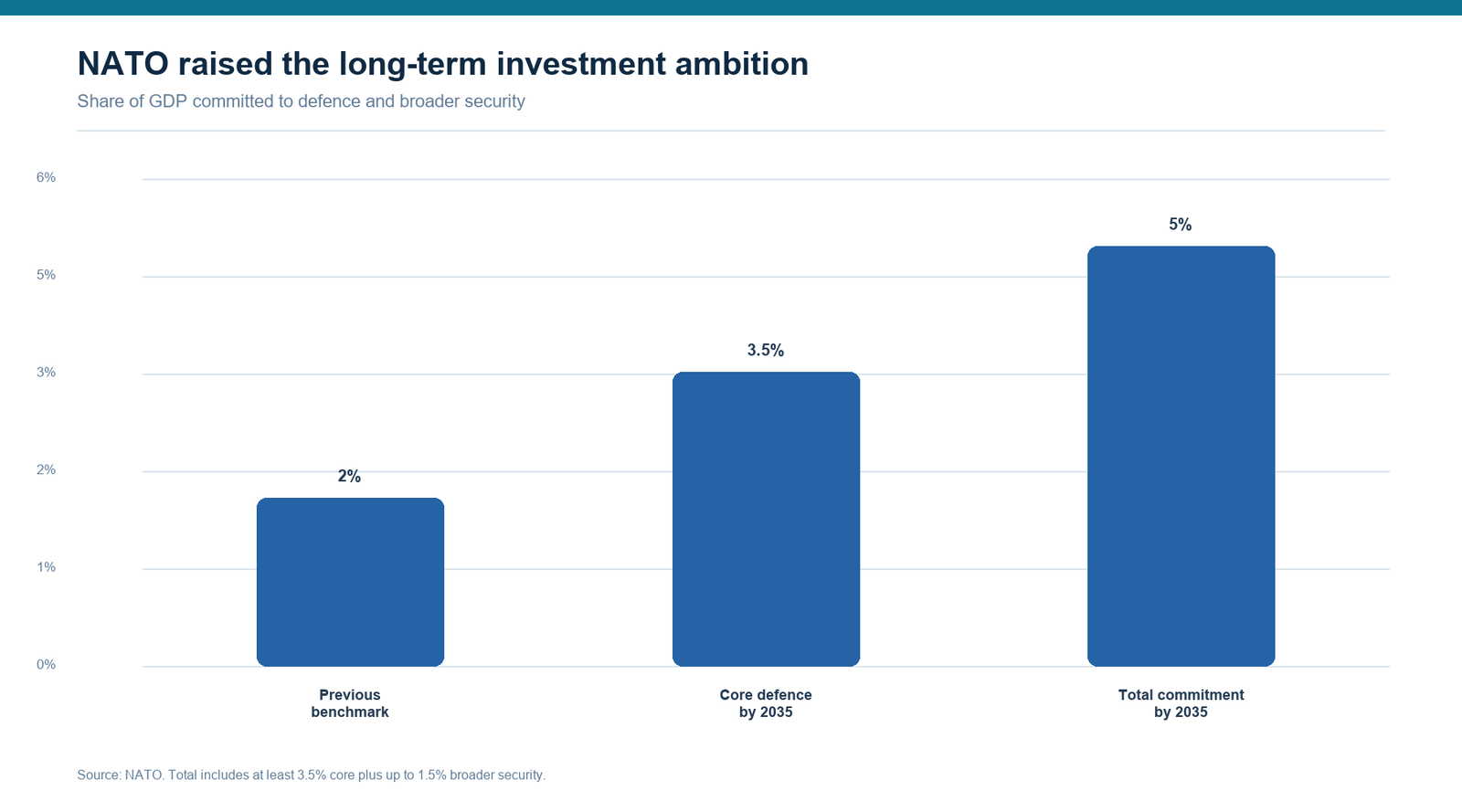
Europe’s defence investment story has moved beyond a temporary response to war. NATO allies have committed to spending 5% of GDP on defence and security by 2035, including at least 3.5% for core defence. European allies and Canada increased defence expenditure by nearly 20% in real terms in 2025.
For investors, that creates unusually long demand visibility. It does not make every defence share cheap—and several headline winners offer modest yields—but it can support earnings and dividend growth for years.
The investable universe
| Company | Home market | Exposure | Dividend profile | Key risk |
|---|---|---|---|---|
| BAE Systems | UK | Air, maritime, land, electronics | Established progressive payer | Valuation and programme execution |
| Leonardo | Italy | Helicopters, electronics, aircraft | Recovery and growth potential | State influence, cyclicality |
| Thales | France | Defence electronics, cyber, aerospace | Quality compounder profile | Premium valuation |
| Rheinmetall | Germany | Land systems and ammunition | Rapid growth, low starting yield | Expectations already extreme |
| Saab | Sweden | Aircraft, sensors, missiles | Growth-oriented dividend | Capacity expansion risk |
| Airbus | Europe | Civil aerospace plus defence/space | Diversified cash generator | Civil production and supply chain |
Backlog is the bridge from budgets to dividends
Political commitments do not automatically become shareholder returns. Watch order intake, book-to-bill ratio and funded backlog. A multiyear contract can support factory utilization and cash flow; an unfunded political announcement cannot. Also check advance payments: they can temporarily flatter cash conversion.
Why the highest-growth company may not be the best dividend stock
Rheinmetall and Saab have enjoyed exceptional demand and investor attention, but starting valuation matters. BAE and Thales may offer a more balanced combination of backlog, cash conversion and dividend history. Airbus provides diversification but carries large civil-aerospace exposure.
UK-focused readers can compare BAE with our UK dividend-stock guide; continental investors should also review the German and French dividend lists.
Five risks the bullish narrative often omits
- Valuation: a decade of growth can be priced in before it arrives.
- Execution: rapid capacity expansion raises cost and quality risks.
- Government influence: states are customers, regulators and sometimes shareholders.
- Working capital: revenue growth does not guarantee free cash flow.
- Peace and procurement cycles: priorities can change even when baseline spending stays high.
A practical ranking framework
Score each candidate on funded backlog growth, free-cash-flow conversion, net debt, dividend coverage, five-year dividend growth and forward valuation. We would give extra weight to cash conversion and balance-sheet flexibility because factories must expand before many orders become revenue.
Our conclusion
BAE Systems is the clearest conventional dividend candidate; Thales offers a quality-growth balance; Leonardo has improving fundamentals with more execution risk; Rheinmetall and Saab are primarily growth investments that happen to pay dividends. Airbus is the diversified alternative. For most investors, position sizing matters more than selecting the single perfect name.
International investors should calculate after-tax income using our withholding-tax guide and consider a diversified approach through our European UCITS ETF guide.
From geopolitical thesis to investment discipline
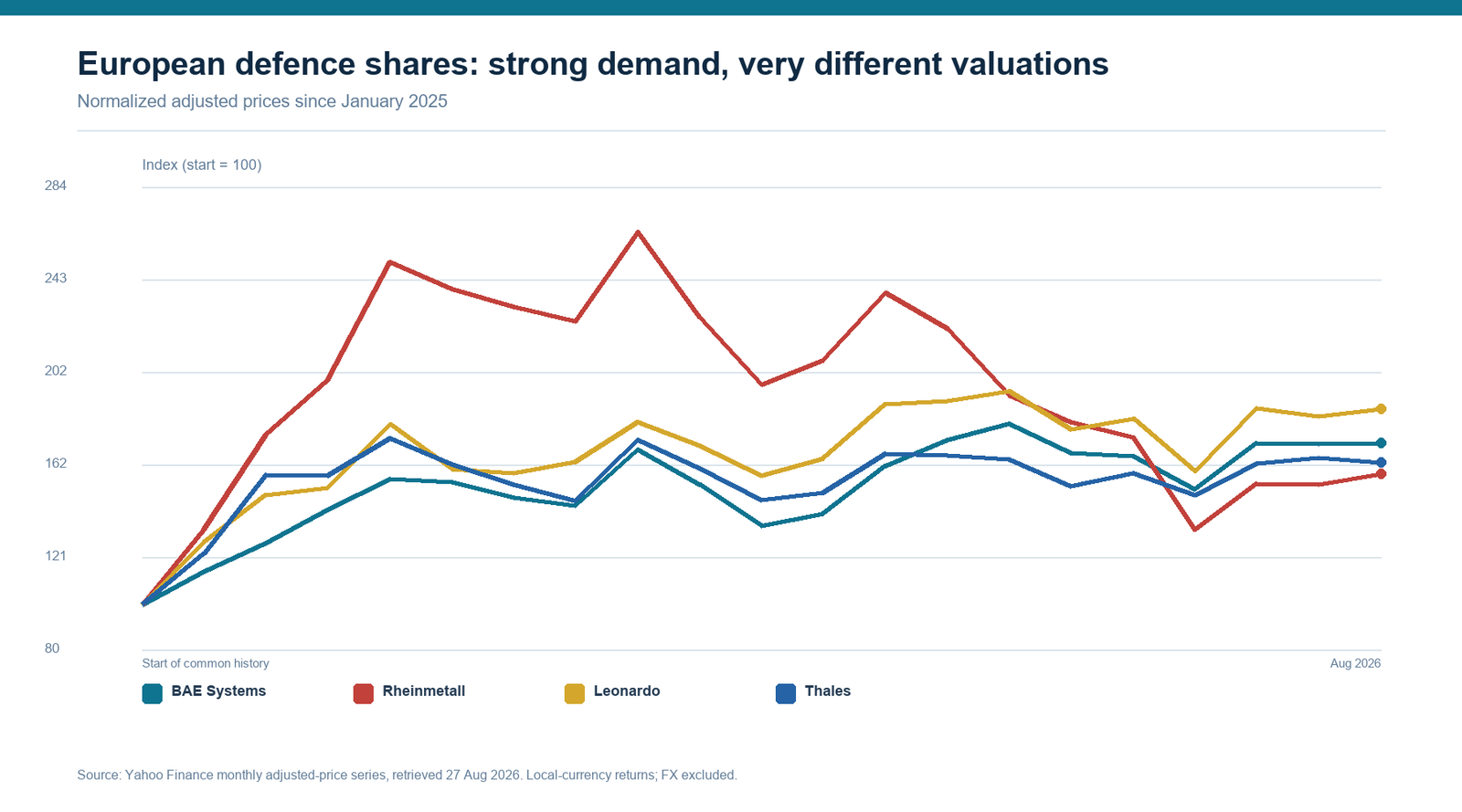
The spending chart supports the long-term demand case. The market chart is the valuation warning: several companies have already rerated sharply, and future shareholder returns depend on converting orders into cash—not simply announcing a larger backlog.
Editorial view: BAE remains the clearest income-oriented candidate, while Rheinmetall, Leonardo and Thales require a stronger growth assumption. The best company and the best-priced share are not necessarily the same.
Quarterly evidence to track
Monitor funded order intake, book-to-bill, production capacity, milestone payments, free-cash-flow conversion and pension-adjusted leverage. Compare reported margins with the proportion of fixed-price contracts: inflation or delays can make a record backlog less profitable than it appears.
Because the line chart uses local currencies, a Swiss, euro or dollar investor must separately model exchange rates. Dividend declarations, withholding tax and currency conversion determine spendable income.
Sources
Budget framework: NATO’s 5% commitment and 2026 defence investment update. Company conclusions require verification against the latest annual and interim reports.
How to value a defence company
Price-to-earnings is only the beginning. Defence businesses carry long contracts, milestone payments, pension obligations and programme risk. Compare enterprise value with normalized free cash flow, then test how margins change if supply costs rise or deliveries slip.
Backlog quality matters more than backlog size. Ask how much is funded, fixed-price versus cost-plus, exposed to inflation, and scheduled for delivery within five years. A huge order book can destroy value if management underpriced the work.
Income investor scorecard
| Factor | Why it matters | Preferred signal |
|---|---|---|
| Book-to-bill | Shows whether demand replenishes revenue | Above 1 over a multiyear period |
| Cash conversion | Funds capex and dividends | Consistent, not advance-payment driven |
| Net debt | Preserves flexibility | Manageable after pensions and leases |
| Payout ratio | Measures dividend buffer | Covered by normalized free cash flow |
| Valuation | Determines future return | Supported by realistic delivery growth |
Direct stocks or a defence ETF?
A single company offers more upside if its programmes execute well, but also exposes the investor to contract failures and political decisions. An ETF reduces company-specific risk but may hold US contractors, non-dividend payers or expensive recent winners. European investors should inspect index rules, domicile, withholding tax, currency exposure and fund size.
Ethical considerations
Defence investing is personal. Some investors exclude weapons entirely; others distinguish defensive systems, cybersecurity and civil resilience. Decide the boundary before looking at returns, then verify revenue exposure rather than relying on a company label.
Frequently asked questions
Does higher NATO spending guarantee higher dividends?
No. Budgets must become funded contracts, contracts must become profitable deliveries, and profits must become free cash flow before shareholders benefit.
Which company has the highest yield?
The answer changes with prices and annual declarations. More importantly, the highest current yield may have the weakest growth. Compare five-year dividend growth and cash coverage.
What currency risk applies?
BAE reports in sterling, Thales and Leonardo in euros, Saab in kronor and Rheinmetall in euros. Your home-currency income can rise or fall even if the local dividend is unchanged.