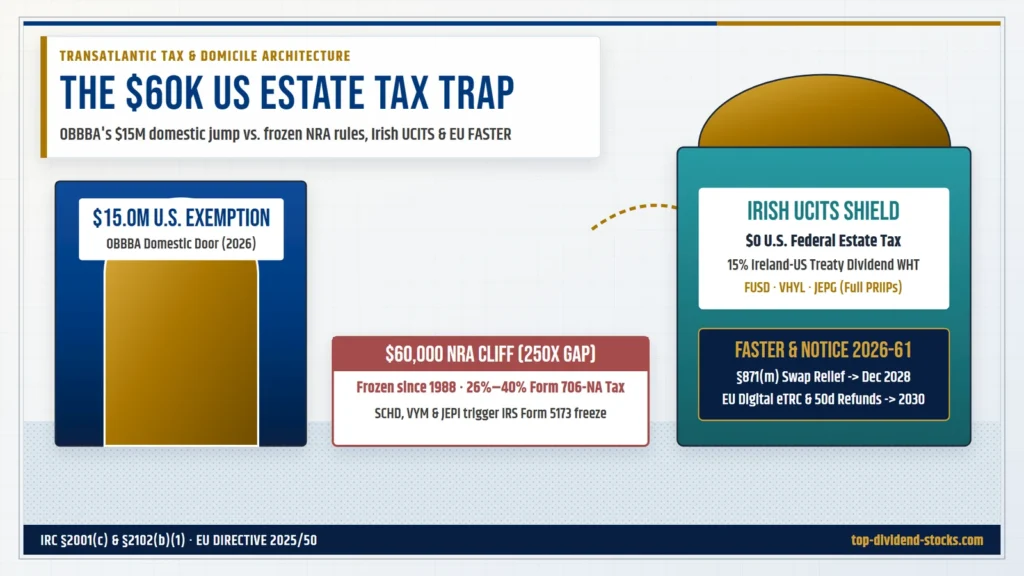
When the One Big Beautiful Bill Act (OBBBA) permanently raised the U.S. federal estate tax exemption to $15,000,000 per citizen starting in 2026, most American retirement savers stopped worrying about federal death duties. For a Swiss, Belgian, Spanish, or British income investor building a $250,000 portfolio of SCHD, JEPI, or Realty Income on a European brokerage app, that headline changed nothing. Non-Resident Aliens (NRAs) remain locked at a statutory U.S.-situs threshold frozen since 1988: $60,000.
In 2026, that creates a 250-fold legislative disparity ($15,000,000 versus $60,000) buried inside Form 706-NA compliance rules. Because U.S. corporate shares and U.S.-domiciled exchange-traded funds are classified as U.S.-situs assets regardless of whether they sit inside a Swissquote, DEGIRO, or Interactive Brokers Europe account, an unexpected death can freeze custody accounts while executors negotiate IRS transfer certificates—and expose non-treaty heirs to marginal federal estate tax rates scaling up to 40%.
At the same time, two regulatory timelines took shape during 2026 that redefine cross-border dividend plumbing for non-U.S. investors. First, in September 2026, IRS Notice 2026-61 extended transitional Section 871(m) dividend-equivalent relief through December 31, 2028, preserving breathing room for synthetic UCITS ETFs. Second, the European Union spent 2026 drafting technical XML/XSD schemas for Council Directive (EU) 2025/50 (the FASTER Directive) ahead of its December 31, 2028 transposition deadline and January 1, 2030 go-live. Understanding how U.S. situs rules, bilateral estate treaties, Irish UCITS shields, and FASTER interact separates durable net wealth from unforced cross-border friction.
Executive Summary: Cross-Border Tax & Domicile Rules (November 2026)
- The $60,000 NRA cliff stays unindexed: Under IRC §2102(b)(1), Non-Resident Aliens receive only a $13,000 unified credit sheltering the first $60,000 of U.S.-situs assets—even as U.S. domestic exemptions jumped to $15M under OBBBA in 2026.
- Effective tax ramps fast above $60,000: Applying Form 706-NA Table A (IRC §2001(c)) without treaty relief produces $57,800 in tax on a $250k U.S. portfolio (23.1%), $142,800 on $500k (28.6%), and $532,800 on $1.5M (35.5%).
- Treaty protection is patchy—and bureaucratic: Only ~15 standalone U.S. estate tax treaties (plus Canada’s income treaty protocol) grant pro-rata relief; residents of Spain, Belgium, Sweden, Portugal, Poland, and Singapore carry full statutory exposure.
- Irish UCITS + FASTER shift portfolio design: Irish-domiciled UCITS ETFs (FUSD, VHYL, JEPG) sit outside U.S. estate situs ($0 U.S. estate tax) and capture 15% US dividend treaty rates—while IRS Notice 2026-61 extends synthetic swap protection through 2028.
The 250x Disparity: How $60,000 Became the Quietest Trap in Global Investing
Twenty-six years ago, the gap between U.S. domestic estate exemptions ($675,000 in 2000) and the $60,000 non-resident allowance was roughly 11-to-1. Subsequent U.S. legislation expanded the domestic threshold aggressively—from $2 million in 2006 to $5 million in 2011, $11.18 million under the 2017 Tax Cuts and Jobs Act, and permanently to $15 million in 2026 under OBBBA—while Congress repeatedly left the $60,000 Non-Resident Alien allowance untouched and unindexed for inflation.
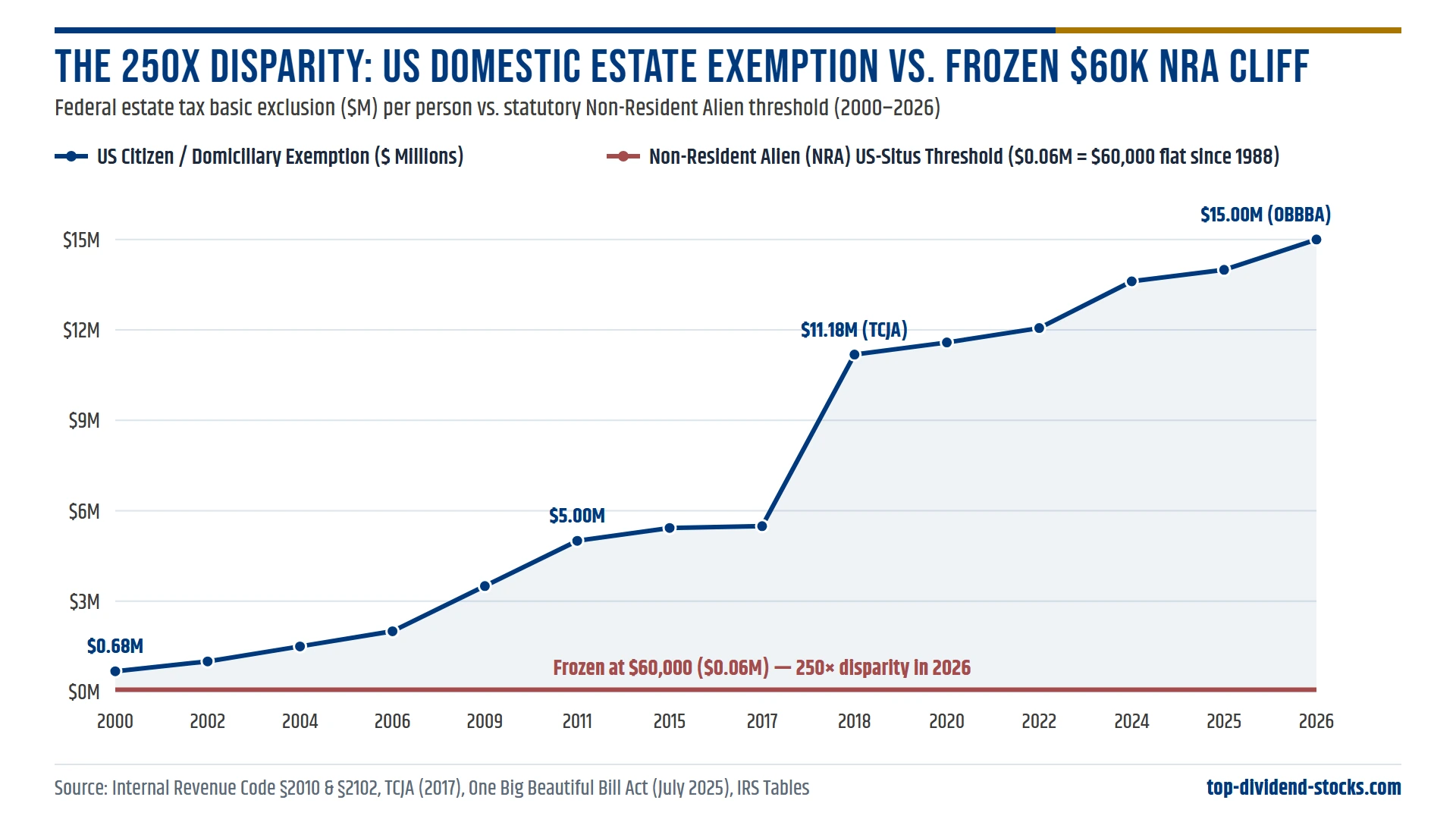
That policy asymmetry catches international dividend investors off guard because brokerage interfaces treat domestic and cross-border tickers identically. Buy $150,000 of Johnson & Johnson, Realty Income, or the Schwab U.S. Dividend Equity ETF (SCHD) through a European or Asian broker, and you cross the $60,000 U.S.-situs filing line on day one. Under IRS rules, any stock of a corporation incorporated in the United States and any U.S.-registered mutual fund or ETF—even one holding European or emerging-market shares like Vanguard Total International Stock (VXUS)—is legally U.S.-situs property.
Critically, foreign brokers that serve as Qualified Intermediaries (QIs) typically freeze a deceased non-resident account until the estate obtains an IRS Transfer Certificate (Form 5173). Clearing that certificate requires filing Form 706-NA within nine months of death, translating probate documents, and appointing U.S. legal counsel—often locking up heirs’ liquidity for 12 to 24 months even when an estate tax treaty ultimately reduces final tax owed to zero.
Form 706-NA Arithmetic: What Non-Treaty Estates Actually Pay
Many online summaries misquote how non-resident estate brackets apply above $60,000. Under Form 706-NA instructions, the IRS calculates a cumulative tentative tax starting from dollar one using the graduated rate schedule in IRC §2001(c) Table A (18% on the first $10,000, stepping rapidly through 20%, 22%, 24%, 26%, 28%, 30%, 32%, 34%, 37%, and 39% up to 40% above $1,000,000), and then subtracts the statutory $13,000 unified credit under IRC §2102(b)(1)—which equals the exact tentative tax on $60,000.
Because that $13,000 credit only absorbs the lowest 18%–24% brackets, the very first dollar above $60,000 enters immediately at a 26% marginal bracket, climbing to 34% above $250,000 and 40% above $1,000,000.
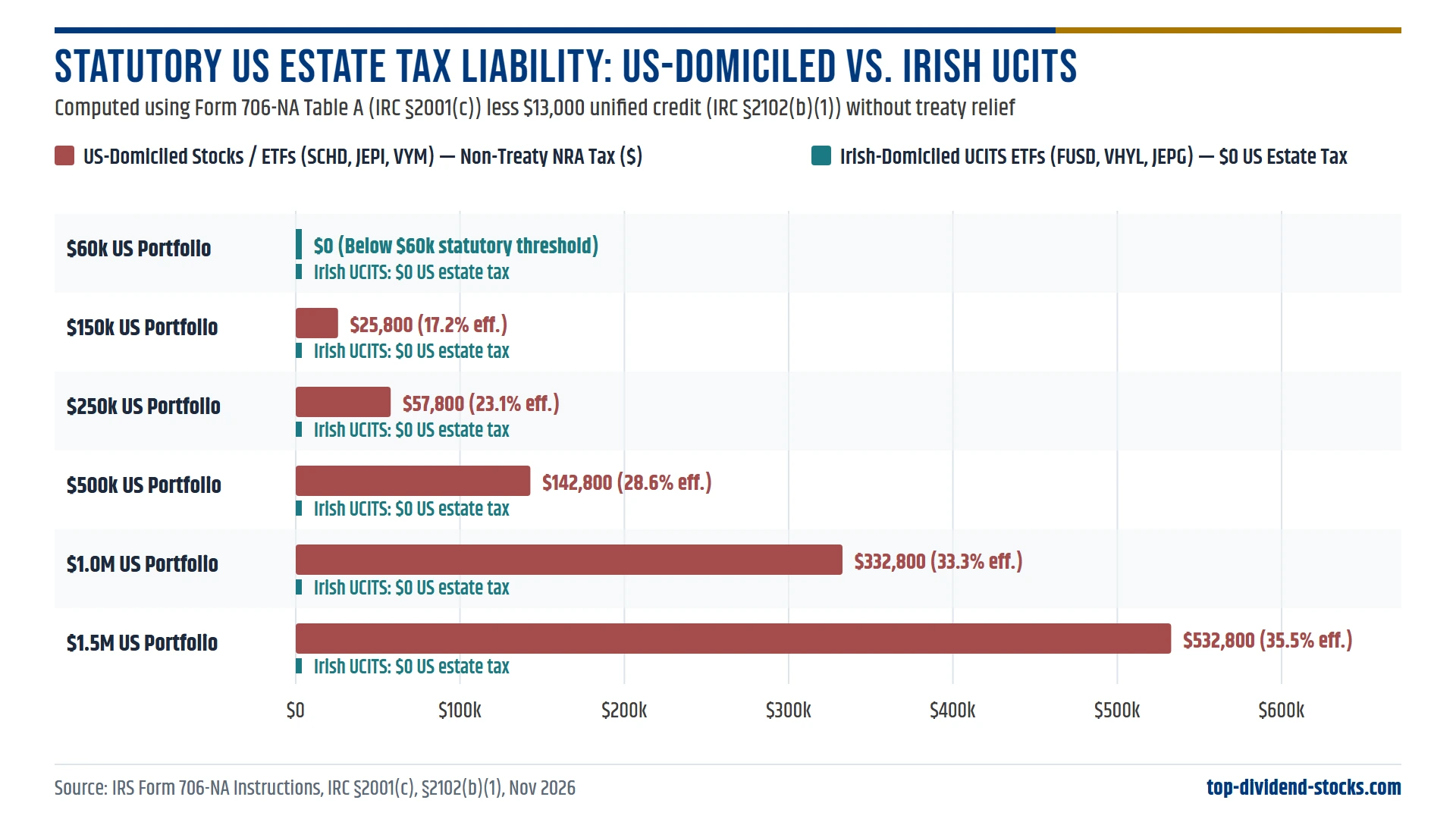
Look at the steepness of Figure 2. On a $250,000 direct U.S. dividend portfolio—roughly the size many European savers target to draw $1,000 a month in income—non-treaty U.S. estate tax takes $57,800 (23.1% of the portfolio). On a $1,000,000 retirement portfolio, IRS liability hits $332,800 (33.3% effective) before local European inheritance taxes are even assessed.
Where Estate Tax Treaties Help—and Where They Leave You Exposed
Unlike income tax treaties—of which the U.S. maintains more than 60 worldwide—the United States has active bilateral estate or gift tax treaties with roughly 15 standalone jurisdictions (including Switzerland, the United Kingdom, Germany, France, the Netherlands, Ireland, Italy, Denmark, Finland, Austria, Greece, Norway, Japan, Australia, and South Africa) plus Article XXIX-B of the U.S.–Canada Income Tax Treaty. Notice who is missing: residents of Spain, Belgium, Sweden (whose legacy treaty terminated in 2008), Portugal, Poland, Luxembourg, Singapore, and Hong Kong have zero U.S. estate tax treaty relief and face the full $60,000 statutory schedule.
Even for residents of treaty countries like Switzerland, relief is rarely effortless. Under the U.S.–Switzerland Estate Tax Treaty, a Swiss resident’s estate does not automatically receive a flat $15 million exemption; instead, it claims a pro-rata unified credit equal to $15 million multiplied by the ratio of U.S.-situs assets to total worldwide gross assets. If a Swiss investor holds $300,000 in U.S. equities inside a $1.5 million worldwide net worth (20% U.S. share), the pro-rata exclusion covers $3.0 million—eliminating U.S. tax, provided the executor discloses the deceased’s entire global asset balance sheet to the IRS via Form 706-NA. For many high-net-worth families, disclosing private global real estate and Swiss pensions to the IRS purely to claim treaty exemption is reason enough to shift core equity allocations out of U.S.-domiciled wrappers altogether.
Irish UCITS ETFs vs. U.S. ETFs: Domicile Shielding, Dividend Leakage & Section 871(m)
For non-U.S. investors looking to replace U.S.-domiciled trackers like SCHD, VYM, or JEPI without surrendering yield or incurring U.S. estate situs, European-listed UCITS ETFs domiciled in Ireland (or Luxembourg) serve as the primary structural shield. Shares of an Irish ICAV or PLC are non-U.S. property under IRS estate tax rules—meaning $0 U.S. federal estate tax and zero Form 706-NA probate clearance regardless of portfolio size.
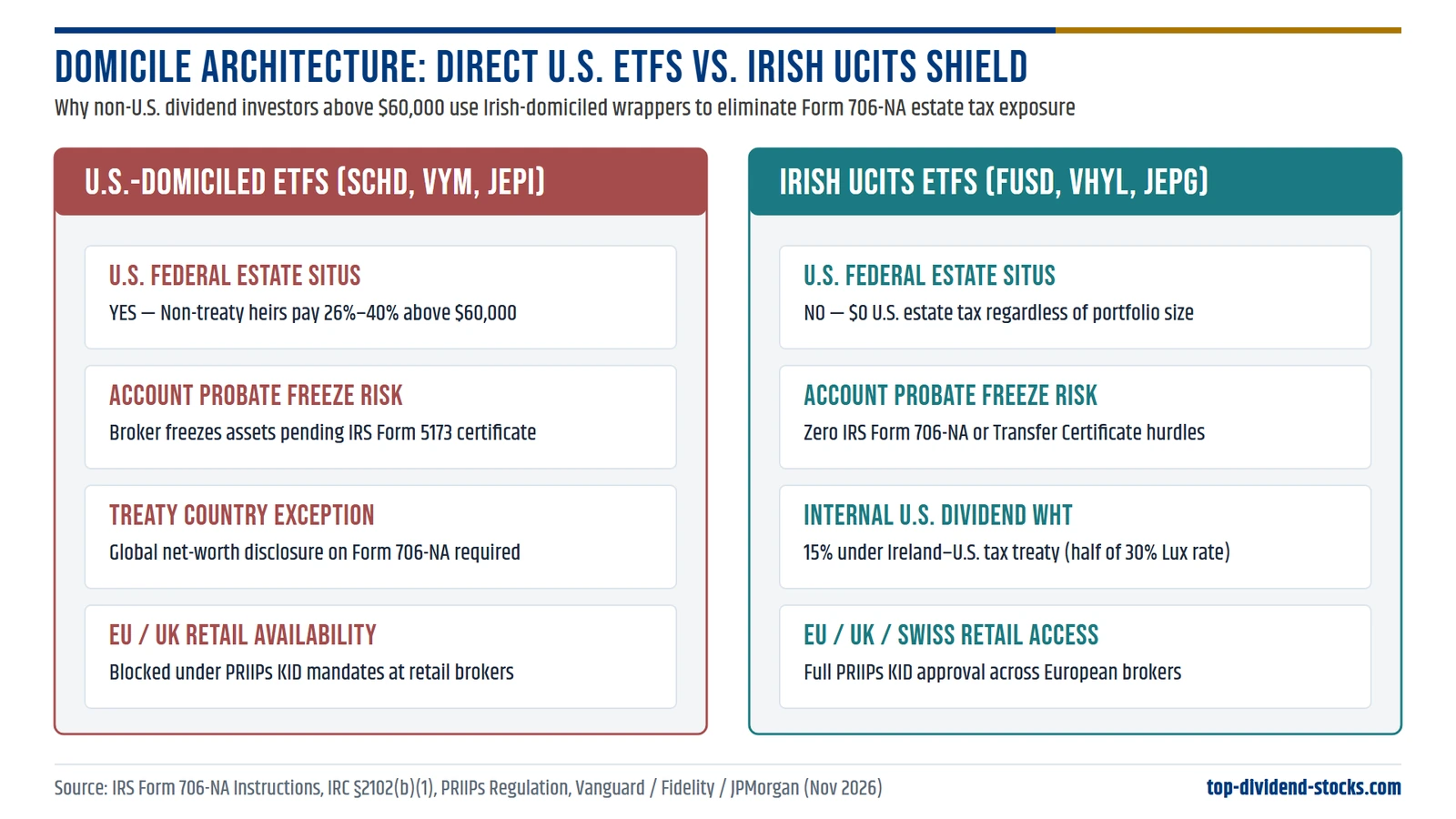
At the income-tax layer, Ireland’s favorable U.S. double-taxation treaty caps withholding on U.S. equity dividends inside a physical Irish UCITS fund at 15% at the fund level—matching the 15% treaty rate an individual Swiss or German investor pays directly on a U.S. stock, while cutting the 30% withholding faced by Luxembourg physical ETFs or non-treaty investors in half. Remember one crucial caveat we detail in our UCITS dividend ETF comparison: because that 15% withholding happens internally between the U.S. company and the Irish fund, non-U.S. individuals usually cannot claim an additional foreign tax credit on their local tax return against the Irish fund’s internal leakage (whereas direct U.S. stock dividends often qualify for local tax-credit offsets in countries like Switzerland).
| Vehicle / Ticker | Domicile | TER | Nov 2026 Yield | U.S. Dividend WHT | U.S. Estate Situs? | PRIIPs KID Access (EU) |
|---|---|---|---|---|---|---|
| SCHD (Schwab U.S. Div. Equity) | United States | 0.06% | ~2.98% | 15% treaty / 30% non-treaty | Yes (>$60k exposed) | Restricted for EU retail |
| VYM (Vanguard High Div. Yield) | United States | 0.04% | ~2.25% | 15% treaty / 30% non-treaty | Yes (>$60k exposed) | Restricted for EU retail |
| JEPI (JPMorgan Equity Prem. Inc.) | United States | 0.35% | ~7.06% (SEC) | 15% treaty / 30% non-treaty | Yes (>$60k exposed) | Restricted for EU retail |
| FUSD (Fidelity US Quality Inc.) | Ireland (UCITS) | 0.25% | ~1.42% | 15% internal fund level | No ($0 estate tax) | Full EU/CH access |
| VHYL (Vanguard All-World High Div.) | Ireland (UCITS) | 0.29% | ~3.0%–4.0% | 15% internal on U.S. sleeve | No ($0 estate tax) | Full EU/CH access |
| TDIV (VanEck Dev. Mkts Div. Leaders) | Netherlands (UCITS) | 0.38% | ~4.0%–5.0% | 15% internal; NL rules apply | No ($0 estate tax) | Full EU/CH access |
| JEPG (JPMorgan Global Eq. Prem. Inc.) | Ireland (UCITS) | 0.35% | ~7.0%–9.0% | 15% internal + option prem. | No ($0 estate tax) | Full EU/CH access |
IRS Notice 2026-61 and Synthetic Swap-Based UCITS ETFs
What about synthetic (total-return swap) Irish UCITS ETFs that replicate broad U.S. indexes like the S&P 500 without directly holding U.S. stocks, historically capturing near-zero dividend withholding leakage? Under IRC Section 871(m), Congress authorized the IRS to treat “dividend equivalent” payments on derivatives tied to U.S. stocks as taxable 30% withholding events. However, full enforcement on complex and non-delta-one structures has been repeatedly deferred—and in September 2026, IRS Notice 2026-61 formally extended transitional Section 871(m) relief through December 31, 2028.
For European investors holding swap-based UCITS trackers on broad qualified U.S. indices, Notice 2026-61 preserves structural stability for another two years, while Qualified Derivatives Dealers (QDDs) manage compliance inside the swap spread. Even so, note that most high-dividend factor funds—including FUSD, VHYL, and JEPG—remain physically replicated because bespoke dividend screens rarely qualify for the narrow broad-index swap exemptions favored by regulators.
The EU FASTER Directive (2025/50): What Changes—and What Waits Until 2030
While U.S. estate and Section 871(m) rules dominate transatlantic holdings, European dividend investors face an equally frustrating domestic drag: reclaiming excess withholding tax on European shares such as Nestlé (35% Swiss WHT), Allianz (26.375% German WHT), or TotalEnergies (25% French statutory rate). Today, recovering the gap above a 15% tax treaty cap still involves slow paper forms, physical tax-residency stamps, and custodian fees that routinely exceed the dividend on small positions—friction documented across 30+ jurisdictions in our dividend withholding tax guide.
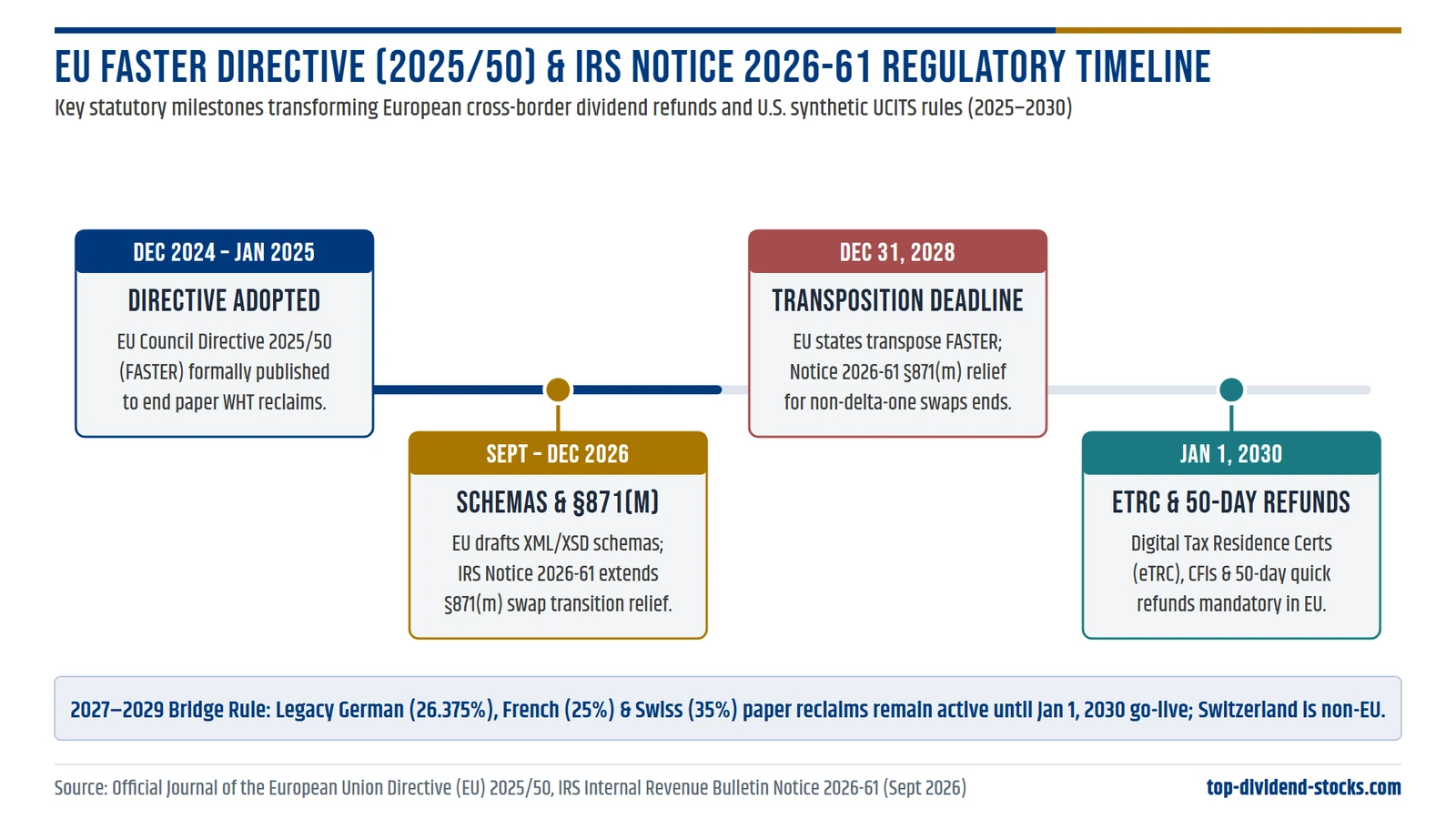
Adopted formally in December 2024 / January 2025 as Council Directive (EU) 2025/50, the EU’s FASTER framework (Faster and Safer Relief of Excess Withholding Taxes) is designed to end that paper bottleneck. Across 2025 and 2026, the European Commission has been drafting harmonized XML/XSD technical schemas and reporting guidelines before EU Member States hit their December 31, 2028 transposition deadline and mandatory January 1, 2030 application date.
When FASTER goes live on January 1, 2030, three institutional pillars will reshape European cross-border dividend collection:
- Common EU Digital Tax Residence Certificate (eTRC): Standardized electronic residency proofs issued automatically by national tax authorities, allowing multi-country investors to reuse one digital credential across calendar-year claims.
- Mandatory Relief-at-Source or 50-Day Quick Refund: Member States must offer either treaty-rate relief directly on dividend payday or an automated refund within 50 days of payment for publicly traded equities held through compliant custodians.
- Certified Financial Intermediaries (CFIs): Major European brokers, banks, and central securities depositories must register as CFIs and report standardized transaction trails to source tax authorities to prevent Cum/Ex-style double claims.
Until January 1, 2030, legacy German, French, and Nordic paper reclaim rules remain fully in force—so broker choice and UCITS wrapper selection decide how much European dividend actually lands in your pocket during 2027–2029.
Cross-Border Implementation Reality Check
One important nuance for Swiss-resident investors reading about FASTER: Switzerland is not an EU Member State, so EU Member States will not automatically treat Swiss residents under intra-EU automated eTRC portals unless bilateral equivalence or non-EU custodian onboarding extends via registered CFIs. Meanwhile, Switzerland’s own 35% domestic withholding tax remains easily reclaimed by Swiss tax residents via annual domestic filings—though foreign investors holding Swiss dividend champions must still utilize paper or portal reclaim tools until Swiss-EU reciprocal digital workflows evolve.
Practical Cross-Border Portfolio Blueprint for 2026–2030
Non-Treaty Residents (Spain, Belgium, Sweden, Singapore, Portugal)
- Hard-cap U.S.-situs assets below $60,000: Keep direct U.S. equities and U.S. ETFs strictly under $60k aggregate market value to avoid Form 706-NA and 26%–40% estate tax brackets.
- Route U.S. & global income via Irish UCITS: Use FUSD, VHYL, or JEPG for scalable core exposure with $0 U.S. estate situs and 15% internal U.S. dividend WHT.
- Pair with 0%-WHT UK & Canadian C-Corps: Add FTSE 100 payers (0% UK dividend WHT) and Canadian names like Enbridge or RBC outside U.S. situs.
Treaty Residents (Switzerland, UK, Germany, France, Netherlands)
- Balance Swiss/local tax credits vs. probate friction: Swiss residents can reclaim the full 15% U.S. treaty WHT via Form DA-1 on direct U.S. stocks, whereas Irish UCITS lose that 15% internally—yet spare heirs Form 706-NA global disclosure.
- Stay selective with direct U.S. single stocks: Reserve direct U.S. holdings for high-conviction names like screened BDCs or REITs where no UCITS alternative exists, monitoring pro-rata worldwide ratios.
- Audit custodian CFI readiness: Check whether your European broker handles automated WHT vouchers and DA-1/tax statements ahead of FASTER.
Bottom-Line Action Steps Before Your Next Purchase
Cross-border tax leakage rarely shows up on a stock screener’s yield column, yet a single domicile error can cost far more than a 0.20% ETF fee difference. Before adding your next dividend ETF or U.S. single stock from outside the United States, apply three checks:
- Audit your total U.S.-situs exposure today: Add every U.S.-incorporated stock and U.S.-domiciled ETF (SCHD, VYM, JEPI, VTI) across all brokerage accounts—even European brokers—and check whether the sum clears $60,000.
- Verify your country’s U.S. estate treaty status: If you reside in a non-treaty jurisdiction, migrate excess U.S.-situs positions into Irish UCITS equivalents (FUSD, VHYL, JEPG) or UK/European payers rather than leaving heirs exposed to Form 706-NA tax.
- Match fund wrapper to local tax-credit rules: Compare 15% non-recoverable Irish UCITS withholding against your domestic foreign tax credit eligibility (such as Switzerland’s DA-1), and prepare custodial records for EU FASTER’s 2028–2030 digital shift.
Methodology & Legal Calculation Notes (Form 706-NA & FASTER)
Non-Resident Alien estate tax figures are calculated strictly from IRC §2001(c) Table A tentative tax schedules minus the $13,000 unified credit under IRC §2102(b)(1), assuming no charitable/marital deductions or bilateral estate treaty pro-rata credit. Tax owed equals $5,200 at $80k, $10,800 at $100k, $25,800 at $150k, $57,800 at $250k, $142,800 at $500k, $332,800 at $1.0M, and $532,800 at $1.5M.
This article provides educational research on statutory tax rules as of November 2026 and does not constitute individualized legal or tax advice. Consult a qualified cross-border estate planner for domicile-specific structuring.
Primary Sources and Regulatory References
- Internal Revenue Service (IRS): Instructions for Form 706-NA — Nonresident Noncitizen Estate Tax Return thresholds, $13,000 credit, and U.S.-situs rules.
- IRS International Estate & Gift Tax Treaties Directory — Active bilateral estate and gift treaty jurisdictions.
- IRS Internal Revenue Bulletin / Notice 2026-61 (September 2026) — Extension of Section 871(m) dividend-equivalent transition relief through December 31, 2028.
- Official Journal of the European Union: Council Directive (EU) 2025/50 (FASTER Directive) — eTRC, 50-day quick refund, CFI reporting, Dec 2028 transposition, and Jan 2030 effective date.
- justETF, Vanguard, Fidelity, and J.P. Morgan Asset Management — 2026 UCITS & U.S. ETF TERs, domiciles, and yields.