When MPLX LP (MPLX) declared a quarterly distribution of $1.2111 per unit in late October 2026—a third straight 12.5% annual step-up—and Enterprise Products Partners (EPD) closed Q3 2026 retaining $1.1 billion in surplus Distributable Cash Flow at 1.9x coverage, North American midstream operators confirmed a quiet transformation. The debt-heavy pipeline partnerships that slashed payouts in 2020 and 2021 have become self-funding cash machines paying 5.8% to 8.5% yields.
Two forces drive that earnings durability in late 2026: multi-year take-or-pay contracts and an unexpected surge in natural gas demand from artificial intelligence data centers. With hyperscale campuses across PJM and ERCOT bypassing multi-year grid interconnection queues via localized gas turbines, industry forecasts project U.S. data-center natural gas burn climbing from roughly 2.8 Bcf/d in 2025 toward 6 to 8 Bcf/d by 2030. Pipelines handle the toll booth regardless of whether power gets billed to a regulated electric utility or a behind-the-meter gas plant.
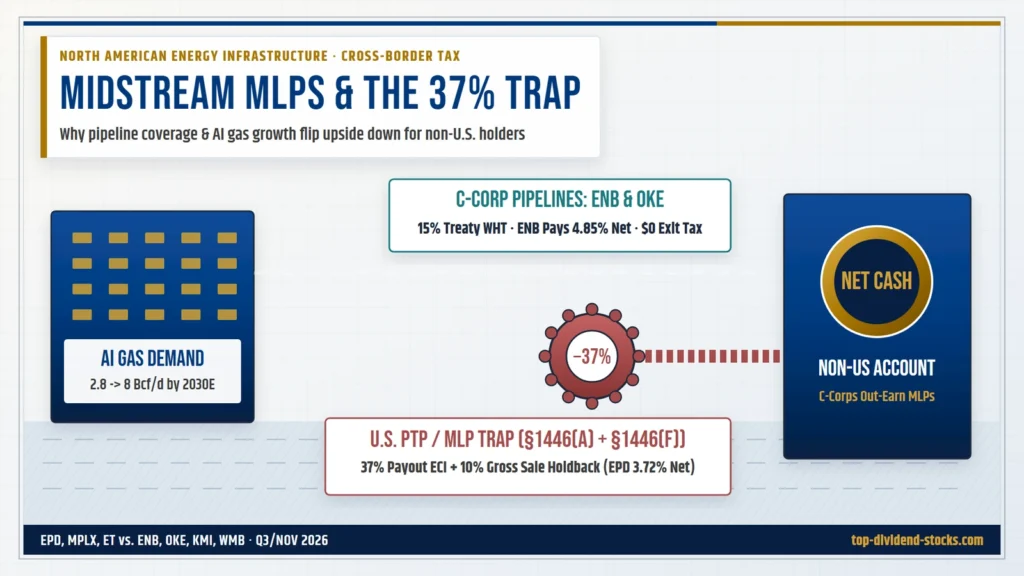
Yet almost every screen comparing midstream MLP dividend stocks misses the cross-border trap embedded in partnership units. If you live outside the United States—in Switzerland, Germany, the UK, or elsewhere in Europe—buying a high-yielding Master Limited Partnership like EPD, MPLX, or Energy Transfer triggers 37% IRC Section 1446(a) Effectively Connected Income (ECI) withholding on quarterly payouts plus 10% Section 1446(f) withholding on gross sale proceeds. Once those rules hit, a 5.90% headline yield on EPD drops to 3.72% net cash—less than Canadian C-Corp pipeline giant Enbridge delivers at 4.85% net with zero partnership tax filings.
Executive Summary: Midstream Income & Tax Audit (November 2026)
- Capital discipline transformed coverage: Leading midstream operators now pair investment-grade leverage (2.9x–3.8x Debt/EBITDA at EPD, KMI, MPLX, WMB) with 1.3x to 2.4x cash coverage, eliminating equity-issuance dilution.
- AI gas load extends pipeline visibility: Data-center gas demand is forecast to more than double from ~2.8 Bcf/d (2025) to 6–8 Bcf/d by 2030, expanding project backlogs at Kinder Morgan ($14.4B backlog), Williams, and Energy Transfer.
- MLP vs. C-Corp tax divide for non-U.S. investors: Under IRS Qualified Notices issued by EPD and MPLX, brokers withhold 37% on ECI distributions for foreign individuals and 10% of gross sale proceeds upon exit—making C-Corps (ENB, OKE, KMI, WMB) dramatically cleaner.
- U.S. taxable investors still win with K-1 deferral: For U.S. taxable accounts (outside IRAs, where UBTI rules apply), MLP distributions classified largely as return of capital defer taxes until sale while compounding tax-deferred.
From Boom-and-Bust Builders to Self-Funding Toll Roads
A decade ago, midstream partnerships financed aggressive pipe construction through constant secondary unit offerings and cheap revolving credit. When oil collapsed in 2015–2016 and again in 2020, capital markets shut off, forcing high-leverage operators to slash distributions. Energy Transfer (ET) famously cut its quarterly payout in half during late 2020–2021 before spending five years paying down debt and rebuilding distributions back above pre-cut levels.
The post-2021 midstream model inverted that capital allocation hierarchy. Rather than paying out 95%+ of Distributable Cash Flow (DCF) and issuing equity for growth projects, bellwether operators now retain significant internal cash flow to fund growth capex and unit buybacks directly off the balance sheet. Look at the dispersion in Q3 2026 balance sheets: Enterprise Products Partners operates at 2.9x adjusted net leverage inside a 2.7x–3.25x corridor; Kinder Morgan stands at 3.5x; Williams runs at 3.80x targeting 3.75x; and MPLX maintains 3.8x safely below its 4.0x ceiling.
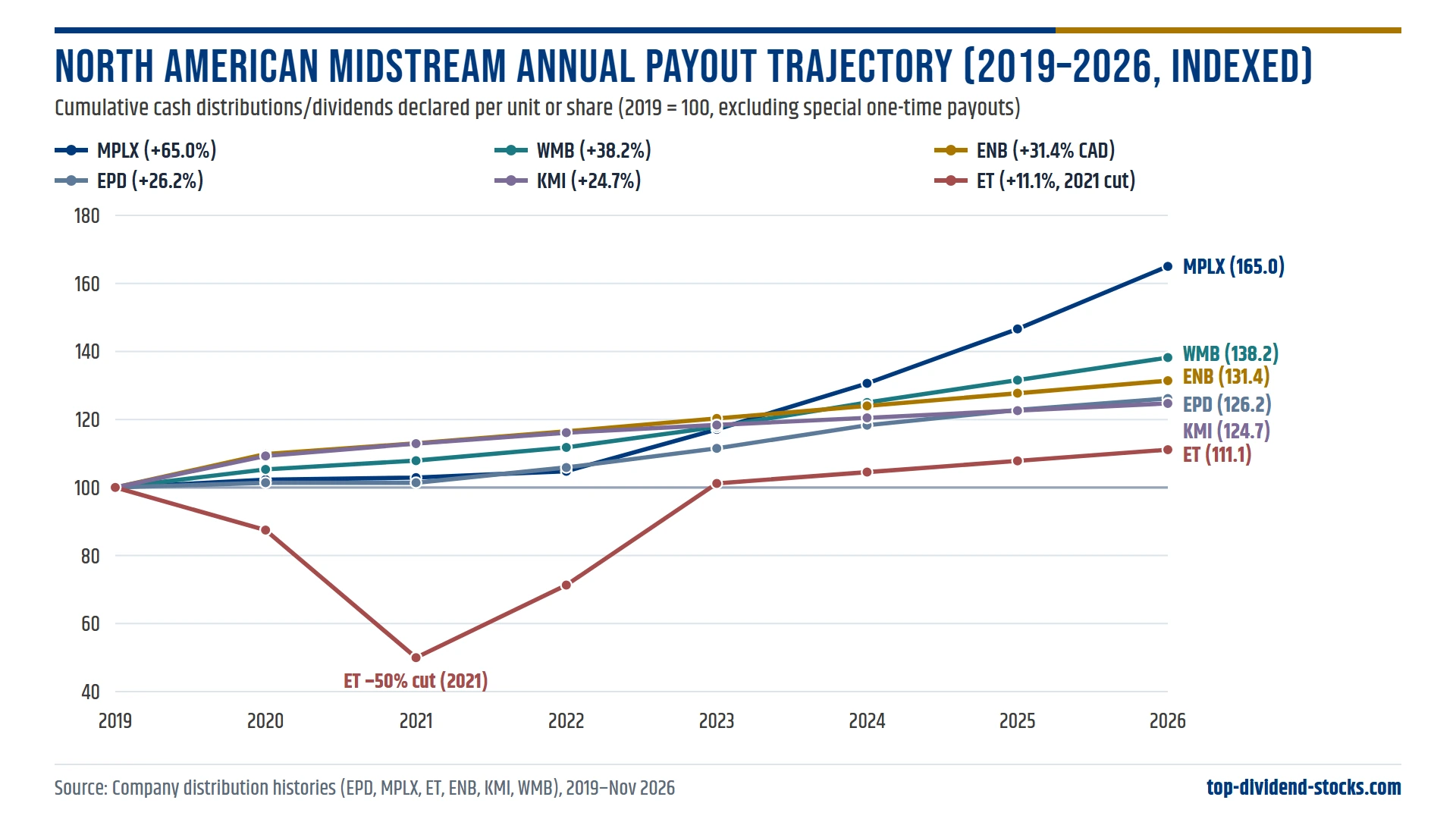
Figure 1 highlights the multi-year payout divergence that headline yield screens conceal. MPLX compounded its base distribution by +65.0% between 2019 and its 2026 cumulative trajectory (accelerating further with Q3 2026’s $1.2111 quarterly step-up), while Williams (WMB) expanded dividends by +38.2% and Enbridge (ENB) advanced +31.4% in Canadian dollars across its regulated utility and gas transmission footprint. EPD (+26.2%) and KMI (+24.7%) delivered steady, unbroken annual raises, whereas Energy Transfer—after cutting 50% in 2021—completed 20 consecutive quarterly hikes by Q3 2026 to sit 11.1% above its 2019 baseline.
AI Data Centers and LNG Exports: Why Natural Gas Volume Keeps Rising
Earlier decarbonization narratives assumed North American natural gas pipeline throughput would peak in the late 2020s. Artificial intelligence power infrastructure broke that assumption. Training and inference clusters require 24/7 baseload electricity measured in hundreds of megawatts per campus, yet high-voltage electric transmission lines take five to eight years to permit and construct.
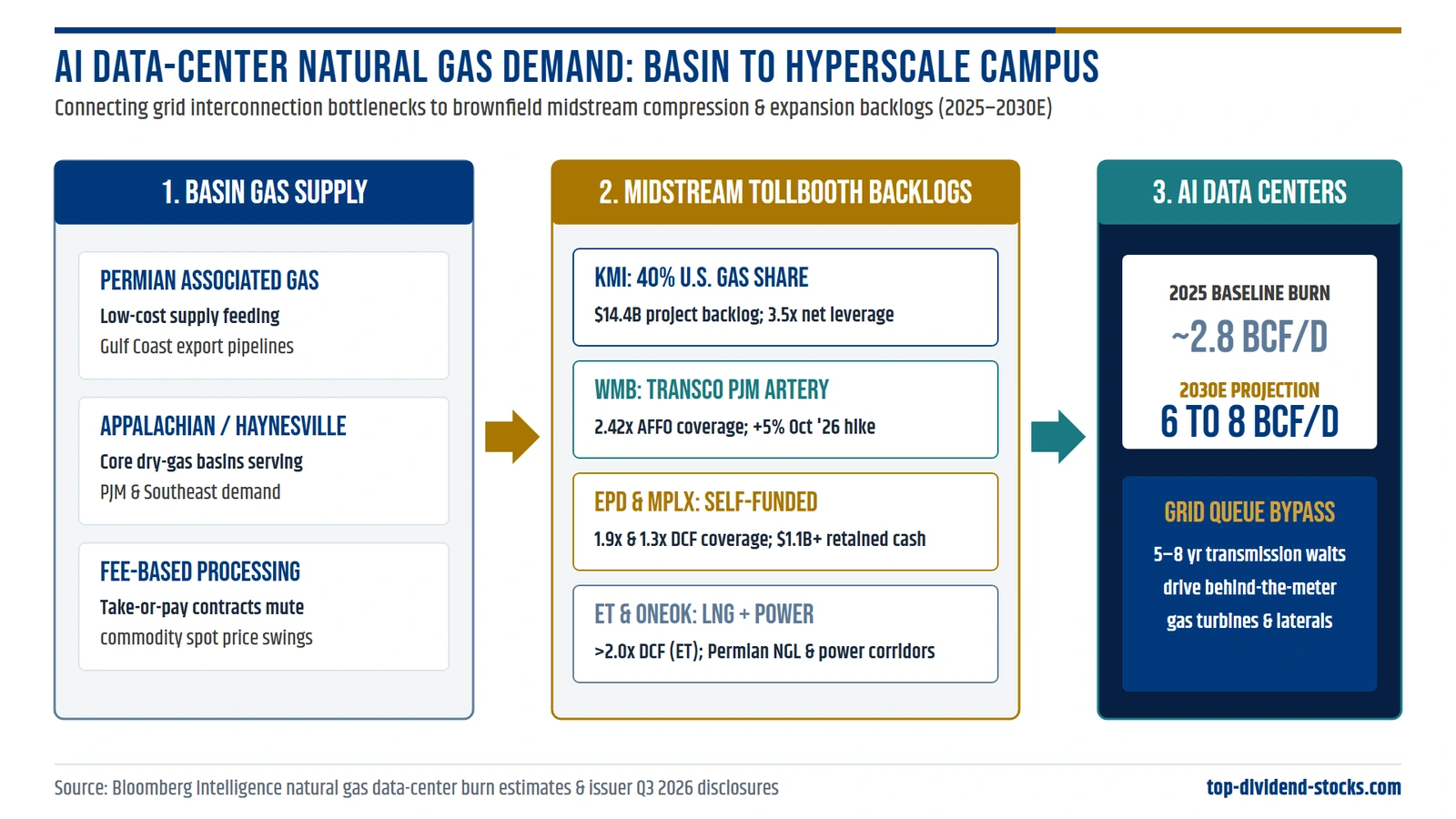
To bypass multi-year grid bottlenecks, hyperscalers and regional power developers increasingly deploy localized or behind-the-meter natural gas generation alongside utility firming contracts—a dynamic we analyzed from the regulated utility side in our reports on FERC’s 2026 grid cost-allocation orders and AI power dividend infrastructure. Bloomberg Intelligence estimates U.S. data-center natural gas consumption will rise from approximately 2.8 billion cubic feet per day (Bcf/d) in 2025 to ~8 Bcf/d by 2030—and still exceed 6 Bcf/d even under slower permitting scenarios.
For midstream dividend payers, volume expansion translates directly into low-risk brownfield compression and lateral pipeline projects rather than speculative greenfield megaprojects:
- Kinder Morgan (KMI): Moves roughly 40% of U.S. natural gas and carries a $14.4 billion project backlog heavily weighted toward power-plant and data-center delivery contracts—explaining why quarterly FCF briefly dipped into a temporary $120M seasonal deficit in Q3 2026 as capital deployment ramped.
- The Williams Companies (WMB): Operates key Transco corridor arteries running directly through high-growth Mid-Atlantic and Southeast data-center regions, supporting 2.42x AFFO dividend coverage and an October 2026 5% dividend increase to $2.10 annualized.
- Energy Transfer (ET) & ONEOK (OKE): Both connect Permian Basin associated gas directly to Gulf Coast LNG terminals and Texas industrial/power loads, generating fee-based throughput insulated from spot natural gas price swings.
- Enterprise Products Partners (EPD): Links Permian natural gas liquids (NGLs) and export docks with long-term fee contracts, keeping coverage near 1.9x DCF while funding growth internally.
The 37% Foreign Tax Trap: IRC Section 1446(a) and 1446(f) Explained
Here is where most midstream dividend analyses go dangerously wrong for international investors. On standard U.S. corporations—such as Johnson & Johnson, Kinder Morgan, or Williams—a Swiss, German, UK, or French investor who files Form W-8BEN receives dividends subject to a 15% treaty withholding tax (and often 0% capital gains tax in the U.S. upon selling shares). Publicly Traded Partnerships (PTPs), commonly known as MLPs, operate under a completely different Internal Revenue Code regime.
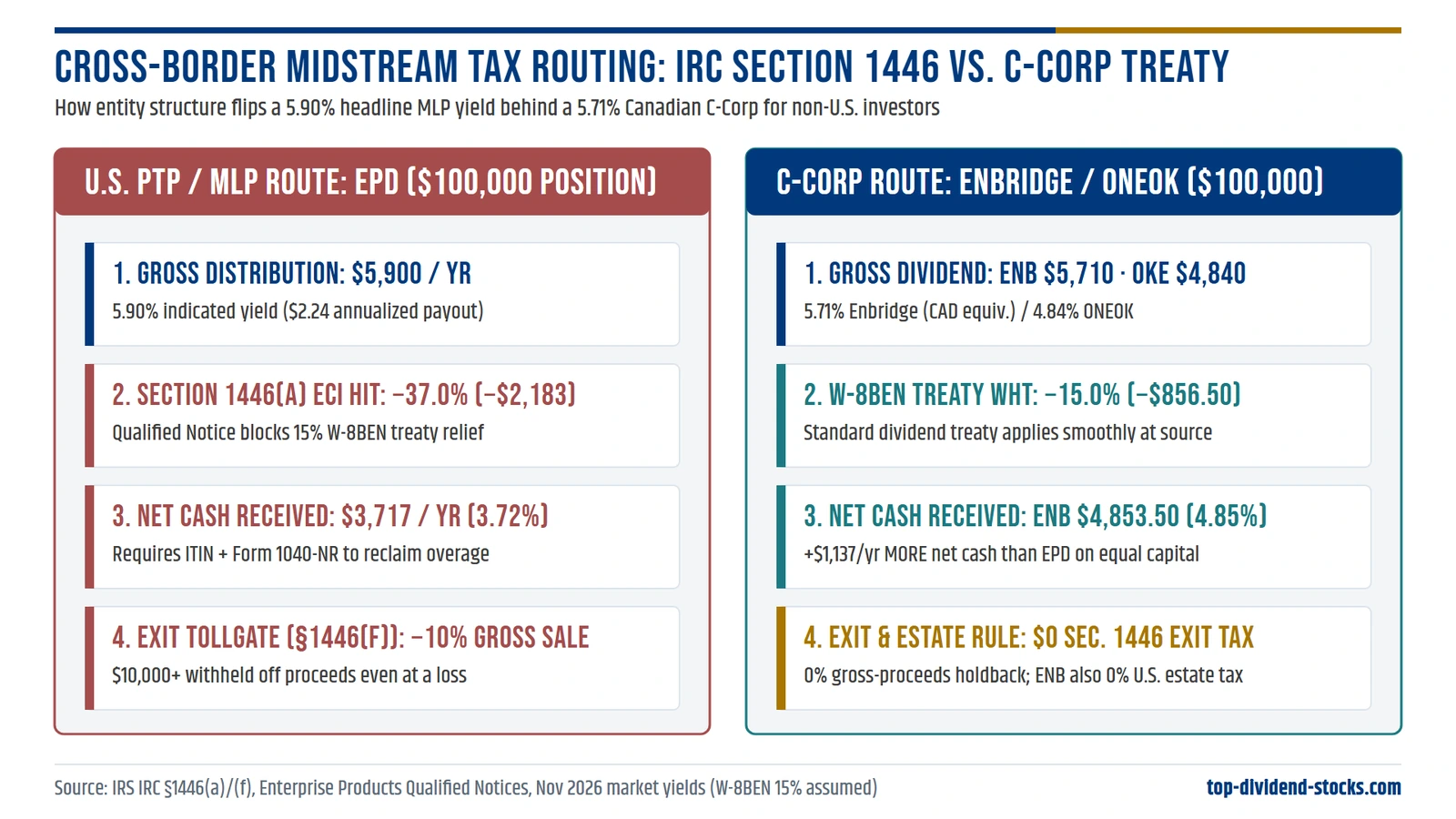
Because MLPs like EPD, MPLX, and ET do not pay entity-level corporate income tax, their operating pipeline income passes directly through to partners as Effectively Connected Income (ECI) from a U.S. trade or business. That tax pass-through creates three painful layers of friction for any Non-Resident Alien (NRA) investor:
- 37% Withholding on Quarterly Distributions (IRC §1446(a)): Under Treasury Regulations §1.1446-4, EPD and MPLX issue Qualified Notices instructing brokers to treat 100% of quarterly distributions paid to non-U.S. investors as U.S. ECI subject to the highest marginal U.S. rate—37% for non-corporate foreign individuals and 21% for foreign corporations. Form W-8BEN’s 15% dividend treaty rate does not reduce ECI withholding.
- 10% Gross-Proceeds Tax on Exit (IRC §1446(f)): When a non-U.S. investor sells units of an in-scope PTP/MLP, the broker must withhold 10% of the total gross sale proceeds—not 10% of the capital gain. Even if you sell EPD or ET at a capital loss, 10% of your principal is automatically skimmed at settlement unless the partnership qualifies for a narrow 10% ECI de minimis exception (which neither EPD nor MPLX meets).
- Mandatory IRS Tax Return & ITIN Burden: Recovering over-withheld taxes requires obtaining an Individual Taxpayer Identification Number (ITIN) and filing an annual U.S. nonresident income tax return (Form 1040-NR) using Form 1042-S and Schedule K-1/K-3 statements—a compliance cost that wipes out returns on small or mid-sized European brokerage positions. Worse, many European brokers (including Interactive Brokers Europe, Swissquote, and DEGIRO) outright restrict or block retail clients from buying U.S. PTPs to avoid Section 1446(f) withholding liability.
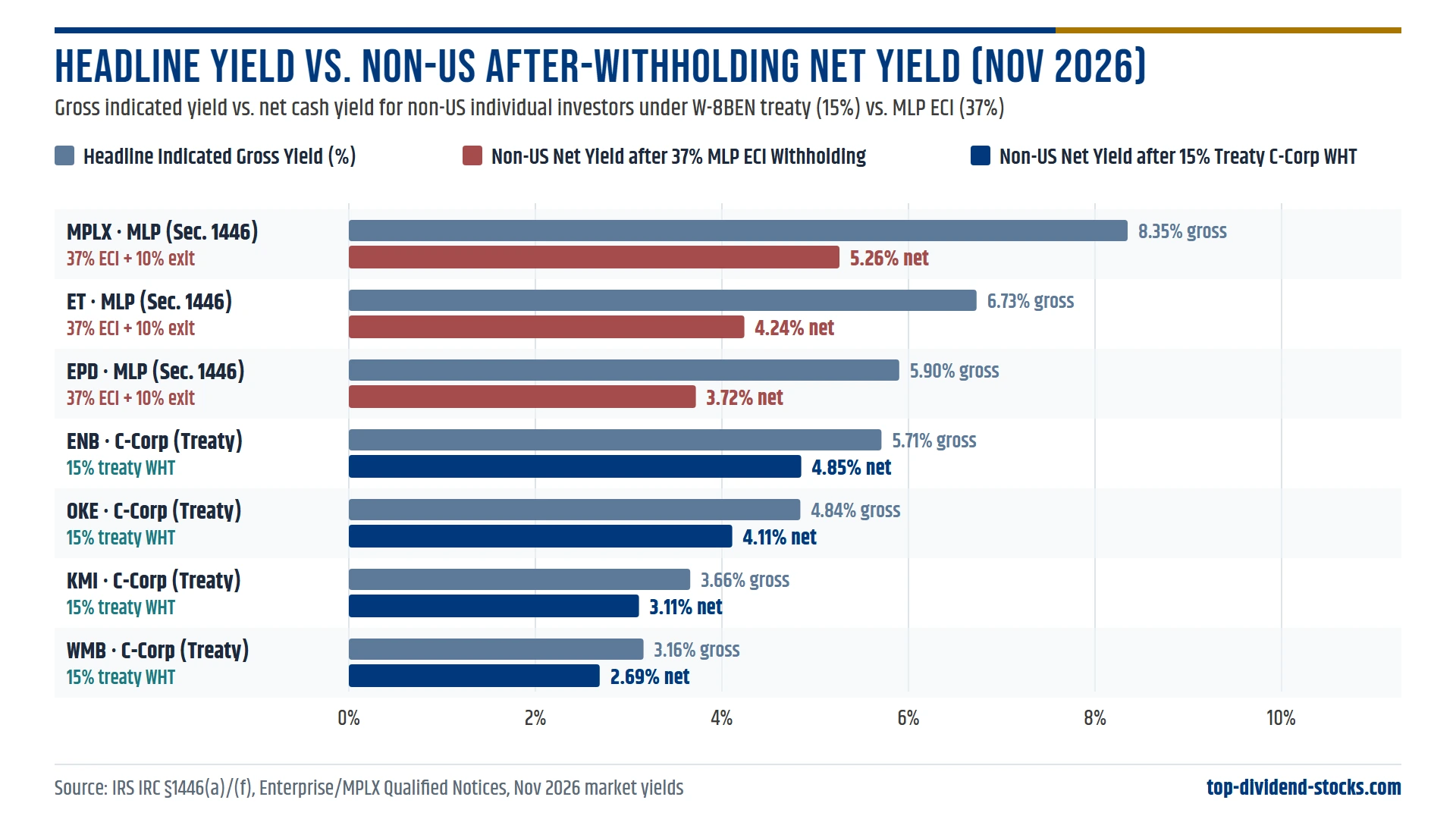
Figure 4 reveals the stark arithmetic reversal produced by corporate structure. At November 2026 prices, EPD advertises a 5.90% gross yield against Enbridge’s 5.71%. After applying the respective non-U.S. withholding rules, EPD pays a foreign individual just 3.72% net (with 10% exit proceeds risk hanging over every sale), whereas Enbridge delivers 4.85% net under a standard 15% Canada-treaty W-8BEN rate—plus 0% U.S. estate tax exposure because Enbridge is domiciled in Canada rather than Delaware! Even ONEOK (4.84% gross → 4.11% net) outperforms EPD on net spendable cash for a European portfolio without triggering Form 1040-NR.
A $100,000 Cross-Border Cash Flow Walkthrough
To see why structural wrapper selection outweighs a 15-basis-point gross yield difference, trace an identical $100,000 allocation held by an individual European or Swiss income investor under November 2026 dividend rates:
- Enterprise Products Partners ($100,000 at 5.90% gross): Generates $5,900 in annual gross distributions. Because EPD’s Qualified Notice treats payouts as U.S. Effectively Connected Income, the custodian strips 37% ($2,183) at source under IRC §1446(a), depositing $3,717 in spendable annual cash (3.72% effective). Exiting that $100,000 stake years later triggers another 10% ($10,000+) Section 1446(f) gross-proceeds holdback until recovered through Form 1040-NR.
- Enbridge Inc. ($100,000 at 5.71% gross): Generates $5,710 in gross CAD-equivalent dividends. Under the standard 15% Canada–treaty W-8BEN rate, withholding claims only $856.50, leaving $4,853.50 in net annual cash (4.85% effective)—nearly $1,137 more spendable income every year than EPD, zero Section 1446(f) exit holdback, and zero U.S. estate-situs exposure.
- ONEOK ($100,000 at 4.84% gross): Generates $4,840 gross and loses 15% ($726) to U.S. treaty withholding, paying $4,114 net cash (4.11% effective) without Schedule K-1 preparation or Form 1040-NR audits.
Why U.S. Taxable Accounts Treat MLPs Completely Differently
Inside a U.S. domestic taxable brokerage account, the math reverses cleanly because Schedule K-1 depreciation shields turn headline distributions into tax-deferred cash flow. Across legacy pipeline partnerships like EPD, MPLX, and Energy Transfer, roughly 70% to 90% of annual distributions typically classify as Return of Capital (ROC) rather than currently taxable ordinary income. Each ROC dollar reduces your unit cost basis instead of triggering immediate federal income tax—deferring taxation until you sell the units (when accumulated depreciation recapture is taxed) or allowing long-term holders who leave units in an estate to capture a basis step-up under U.S. law.
Notice two operational boundaries even U.S. investors must respect. First, Schedule K-1 tax packages routinely arrive in late February or March, delaying personal income tax preparation compared with simple Form 1099-DIV statements issued by Enbridge, Kinder Morgan, Williams, and ONEOK. Second, placing large MLP allocations inside a traditional IRA, Roth IRA, or 401(k) risks triggering Unrelated Business Taxable Income (UBTI): whenever aggregate net UBTI from all partnerships inside a retirement account exceeds $1,000 in a tax year, the IRA custodian itself must file Form 990-T and pay trust-rate federal taxes directly out of the sheltered account. Keep K-1 partnerships strictly in taxable U.S. brokerage accounts, and hold C-Corp pipelines inside tax-advantaged retirement wrappers.
Seven North American Midstream Leaders Ranked by Coverage and Tax Fit
The table below pairs verified Q3/November 2026 financial metrics—unit/share price, annualized payout, gross yield, cash coverage, and leverage—with tax structure and investor suitability across three top MLPs and four C-Corp midstream alternatives.
| Ticker | Structure (Tax Form) | Nov 2026 Price | Annual Payout | Gross Yield | Cash Coverage | Leverage (Debt/EBITDA) | Non-US Tax Impact |
|---|---|---|---|---|---|---|---|
| EPD | MLP / PTP (K-1) | ~$38.00 | $2.24 ($0.56/q) | ~5.90% | 1.90x DCF | 2.9x Net | 37% ECI + 10% sale (1446f) |
| MPLX | MLP / PTP (K-1) | ~$58.00 | $4.84* ($1.2111/q) | ~8.35% | 1.30x DCF | 3.8x Debt | 37% ECI + 10% sale (1446f) |
| ET | MLP / PTP (K-1) | ~$20.35 | $1.37 ($0.3425/q) | ~6.73% | >2.0x DCF (<50% payout) | 4.0x–4.5x target | 37% ECI + 10% sale (1446f) |
| ENB | Canadian C-Corp (1099/NR4) | C$67.96 (~$47.30) | C$3.88 (C$0.97/q) | ~5.71% | 60%–70% DCF payout | 4.5x–5.0x target | 15% treaty WHT; 0% Sec. 1446 |
| OKE | U.S. C-Corp (1099-DIV) | ~$88.40 | $4.28 ($1.07/q) | ~4.84% | Fee/processing backed | IG Balance Sheet | 15% treaty WHT; 0% Sec. 1446 |
| KMI | U.S. C-Corp (1099-DIV) | ~$32.50 | $1.19 ($0.2975/q) | ~3.66% | High capex; $14.4B backlog | 3.5x Net | 15% treaty WHT; 0% Sec. 1446 |
| WMB | U.S. C-Corp (1099-DIV) | ~$66.50 | $2.10 ($0.525/q) | ~3.16% | 2.42x AFFO | 3.80x Debt | 15% treaty WHT; 0% Sec. 1446 |
For U.S. domestic investors operating in taxable brokerage accounts, the ranking splits along risk-versus-growth lines. EPD remains the gold standard for conservative balance-sheet safety (2.9x leverage and 1.9x DCF coverage), while MPLX delivers unmatched recent distribution velocity (+12.5% annually for three straight years) backed by Marathon Petroleum’s refining logistics system—though its 1.3x coverage leaves a slimmer buffer than EPD or ET if Permian volume growth cools. Remember too for U.S. investors: avoid stuffing large MLP positions inside IRAs or 401(k)s, where Unrelated Business Taxable Income (UBTI) exceeding $1,000 triggers Form 990-T tax filings inside the retirement shelter.
For European, Swiss, and non-U.S. income investors seeking pipeline cash flow, the ranking flips cleanly toward C-Corps: Enbridge (explored further in our Canadian dividend stocks guide) and ONEOK deliver 4.1%–4.9% net treaty-adjusted yields with straightforward brokerage custody, while Williams and Kinder Morgan offer pure-play exposure to AI natural-gas turbine buildout at 3.1%–3.7% gross yields. Compare these cross-border withholding mechanics with our full dividend withholding tax reference and European dividend broker comparison before placing an order.
Midstream Allocation Architecture by Investor Domicile
U.S. Taxable Investors (K-1 Eligible)
- Anchor with low-leverage MLPs: Pair EPD (2.9x leverage, 1.9x DCF) with higher-growth MPLX (+12.5% hike pace) for 6%–8% tax-deferred cash distributions.
- Keep MLPs out of IRAs: Use C-Corps (ENB, OKE, WMB) or C-Corp-structured ETFs inside tax-deferred retirement accounts to avoid UBTI above $1,000.
- Monitor DCF after maintenance capex: Favor operators retaining surplus cash rather than borrowing to fund payouts.
European, Swiss & Non-U.S. Investors
- Avoid direct U.S. PTP/MLPs: Sidestep the 37% Section 1446(a) payout drag, 10% gross-proceeds sale tax, and Form 1040-NR/ITIN compliance trap.
- Deploy C-Corp alternatives: Own ENB (Canadian domicile, 15% treaty WHT, zero U.S. estate situs) alongside OKE or WMB (within $60k U.S. estate threshold or treaty planning).
- Compare against REITs & BDCs: Balance energy inflation hedges alongside high-yield REITs and screened BDCs.
What Could Break the Midstream Dividend Thesis?
Even self-funding pipeline operators carry three cyclical and regulatory risks worth tracking every quarter. First, excessive capex re-acceleration could repeat the late-2010s mistake: Kinder Morgan’s $14.4 billion backlog and Williams’s expansion commitments improve multi-year EBITDA only if contracted returns clear today’s 5%+ cost of debt. Second, crude and NGL spread compression slows producer drilling in the Permian if WTI drops meaningfully below $60/bbl, trimming gathering throughput volumes on variable-fee contracts. Third, Section 1446 broker compliance tightening has already pushed international custodians to restrict U.S. PTPs—meaning foreign holders holding legacy MLP positions risk forced liquidation with a 10% gross withholding haircut unless transferred or unwound carefully.
Treat midstream energy as a 5% to 10% real-asset income sleeve rather than an all-weather bond substitute—verifying cash coverage ratios above 1.3x, investment-grade leverage under 4.0x (outside utility-like Enbridge), and exact tax plumbing before chasing headline distribution yields.
Methodology, Section 1446 Notes, and Distribution Indexing Calculations
Indexed payout lines (2019 = 100) reflect cumulative regular cash distributions declared per calendar year from 2019 through 2025, plus annualized 2026 quarterly run-rates (excluding one-time special distributions). Enbridge payouts are indexed in native Canadian dollars (C$2.952 in 2019 to C$3.880 in 2026) to eliminate USD/CAD translation noise.
Non-U.S. after-tax yields apply 37% statutory non-corporate ECI withholding under IRC §1446(a) to U.S. MLPs (EPD, MPLX, ET) and standard 15% treaty withholding under W-8BEN to C-Corporations (ENB, OKE, KMI, WMB). Actual reclaim eligibility varies by domicile and Form 1040-NR filing status.
Primary Sources and Regulatory References
- Internal Revenue Service (IRS): Partnership Withholding under IRC Sections 1446(a) and 1446(f) — ECI 37% non-corporate withholding and 10% gross proceeds disposition rules.
- Enterprise Products Partners L.P. Investor Relations — Q3 2026 earnings release ($0.56 distribution, 1.9x DCF coverage, 2.9x leverage, Qualified Notices).
- MPLX LP Investor Relations — Q3 2026 financial results ($1.2111 quarterly distribution, 1.3x coverage, 3.8x leverage).
- Energy Transfer LP Investor Relations & Kinder Morgan Investor Relations — Q3 2026 distribution announcements and project backlogs.
- Enbridge Inc., The Williams Companies, and ONEOK, Inc. — 2026 dividend announcements, AFFO coverage, and leverage guidance.