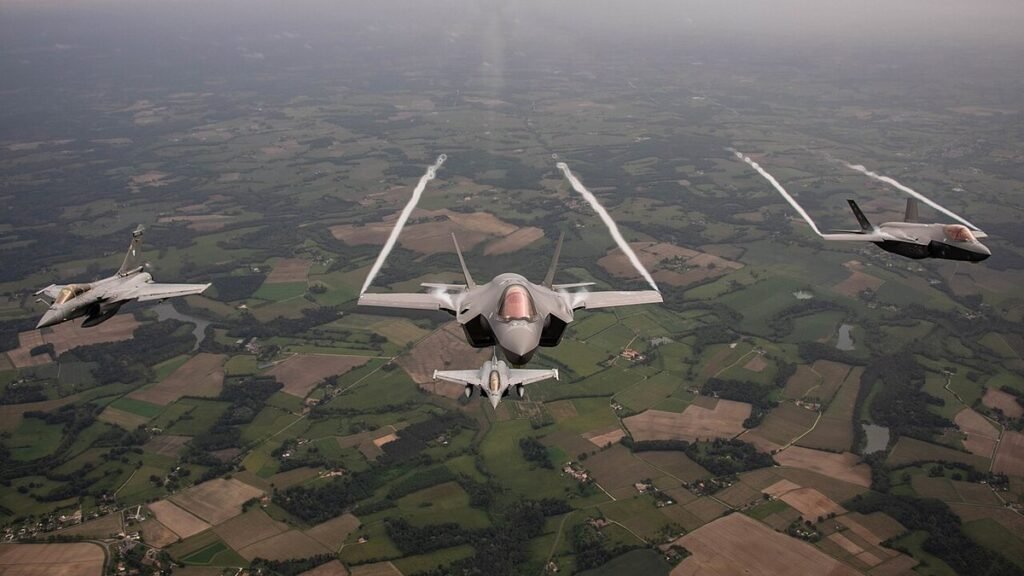
Everyone knows the trade. Europe is rearming, the order books are the fullest they have been since the Cold War, and the share prices have behaved accordingly. It has been the best macro call in European equities for three years and we are not going to pretend otherwise.
But if you are reading this, you are probably buying shares for the income they pay. And on that specific test — how much cash actually reaches your account, and how reliably — the European rearmament trade is currently the worse of the two options. Rheinmetall yields 1.14%. Lockheed Martin yields 2.45% and trades at a third less on forward earnings. That is a strange place for a story this bullish to have ended up, and it is worth understanding why before deciding it is wrong.
What Europe actually committed to
At the Hague summit in June 2025, NATO members agreed to spend 5% of GDP on defence and security by 2035. That headline hides the structure, which matters: at least 3.5% of GDP on core defence requirements, and up to 1.5% on broader defence- and security-related investment — critical infrastructure, cyber, civil preparedness, the industrial base. The trajectory gets reviewed in 2029.
Two things follow. The first is that 2035 is nine years away, and a dividend paid in 2035 is not worth much to someone deciding what to buy this month. The second is that only the 3.5% is guns; the rest can be roads, fibre and port security, which is a much wider pool of beneficiaries than the pure-play defence primes.
The other number everyone quotes needs the same treatment. ReArm Europe’s €800 billion is not €800 billion of orders. Roughly €650 billion of it is flexibility under the Stability and Growth Pact — permission for member states to borrow up to 1.5% of GDP more for defence without breaching the fiscal rules. Another €150 billion is SAFE, an EU loan facility for joint procurement. There are no grants in the headline figure. The Commission itself says the real amount depends on whether member states choose to mobilise the money.
Germany is the exception, and it is the one that counts. In March 2025 the Bundestag and Bundesrat amended the constitution so that defence spending above 1% of GDP is exempt from the debt brake entirely. That is not permission to borrow within a limit — it is the removal of the limit. Germany’s 2026 defence budget runs to roughly €108 billion against about €95 billion in 2025, and is planned to reach around €162 billion by 2029. If you want one fact that explains the German re-rating, it is that constitutional amendment, not the NATO communiqué.
The spending turned later than people remember
European defence budgets did not turn in 2022. They turned in 2023.
Defence expenditure of NATO's European members plus Canada, US$ billions at current prices.
Read the years, not the headline. Russia invaded Ukraine in February 2022, and European spending that year actually fell slightly in dollar terms. Budgets are annual, procurement is slower still, and the money only really started moving in 2023.
NATO, Defence Expenditure of NATO Countries (2014–2025), published 28 August 2025. 2024 and 2025 are NATO estimates. Current prices, so the dip in 2015 is a euro–dollar exchange-rate effect rather than a spending cut.
Show the data
| Year | US$bn | % of GDP |
|---|---|---|
| 2014 | 289.3 | 1.40 |
| 2015 | 254.5 | 1.40 |
| 2016 | 255.6 | 1.41 |
| 2017 | 275.1 | 1.45 |
| 2018 | 300.5 | 1.48 |
| 2019 | 301.7 | 1.51 |
| 2020 | 325.9 | 1.69 |
| 2021 | 358.7 | 1.63 |
| 2022 | 355.4 | 1.63 |
| 2023 | 418.6 | 1.74 |
| 2024 (est) | 516.5 | 1.99 |
| 2025 (est) | 608.0 | 2.27 |
This chart is the one we would put in front of anyone who thinks they arrived early. European and Canadian defence spending was essentially flat in dollar terms from 2014 to 2019. Russia invaded Ukraine in February 2022, and spending that year fell slightly. The money began moving in 2023 and accelerated hard through 2024 and 2025.
Budgets are annual, procurement cycles are longer, and a frigate ordered in 2025 is revenue in 2029. The rearmament is real and it is early in its delivery — but the share prices moved in 2022 and 2023, which is to say they moved a year or two ahead of the cash. That gap between price and cash is the whole argument of this article.
What the two markets actually pay
The rearmament trade pays less than the incumbent it is supposed to replace
Dividend yield, %, twelve listed defence and aerospace groups.
Seven of the eight lowest yields in this group are European. That is not a judgement on the businesses — it is what happens when share prices trebble faster than dividends can follow.
Yields via stockanalysis.com, 28–29 August 2026. BAE's figure is computed against its FY2025 total dividend of 36.3p; aggregator data for BAE carried an error at the time of writing.
Show the data
| Company | Market | Yield | Payout ratio |
|---|---|---|---|
| Lockheed Martin | US | 2.45% | 50.9% |
| L3Harris | US | 1.90% | 50.5% |
| Northrop Grumman | US | 1.81% | 31.4% |
| Thales | France | 1.72% | 53.6% |
| General Dynamics | US | 1.67% | 38.8% |
| BAE Systems | UK | 1.64% | 51.6% |
| Dassault Aviation | France | 1.60% | 36.9% |
| RTX | US | 1.38% | 51.4% |
| Leonardo | Italy | 1.21% | 29.7% |
| Rheinmetall | Germany | 1.14% | 51.0% |
| Safran | France | 0.94% | 16.9% |
| Saab | Sweden | 0.48% | 16.6% |
Seven of the eight lowest yields in that group are European. Before drawing the obvious conclusion, be clear about what it does and does not mean.
It does not mean European defence companies are stingy. Rheinmetall raised its dividend from €8.10 for 2024 to €11.50 for 2025 — up 42% in a single year. BAE’s interim went from 13.5p to 15.0p, up 11%. These are companies raising payouts at rates the American primes have not matched in a decade.
What it means is that the share prices rose faster. A yield is a fraction, and when the denominator triples, a 42% increase in the numerator still leaves you with 1.14%. Nothing has gone wrong. You are simply being asked to pay for growth that has not been delivered yet, and to accept very little current income while you wait.
A caution about “consecutive years of increases”
You will see the US primes marketed on their streaks: General Dynamics at 35 consecutive years, L3Harris 24, Lockheed 23, Northrop 22. Those are real and they mean something — a board that has raised the dividend through three recessions has revealed a genuine preference.
But do not read the absence of a streak in Europe as a warning. Continental payers generally set an annual dividend against a target payout ratio rather than committing to an unbroken sequence, so a flat or lower year follows earnings rather than signalling distress. We could not find a published increase streak for Rheinmetall, Thales, Leonardo, Safran, Saab or Dassault, and that absence is a difference in convention, not in quality. BAE, on the UK model, does run a streak — 21 years.
It does change how you should hold them. A ratio-based payer will cut in a bad year without apology, which makes position sizing and diversification matter more than it does with a Dividend Aristocrat. Our guide to European dividend champions covers which continental payers behave most like the US model.
What you pay for what you are paid
What you pay, and what you are paid
Forward price/earnings multiple against dividend yield. Up and to the left is cheap and generous; down and to the right is expensive and stingy.
Rheinmetall trades at roughly a 38% premium to Lockheed on forward earnings and a 54% premium on EV/EBITDA, while paying less than half the dividend. You can defend that on growth. You cannot defend it on income.
Forward P/E and yields via stockanalysis.com, 28–29 August 2026.
Show the data
| Company | Forward P/E | Trailing P/E | EV/EBITDA | Yield |
|---|---|---|---|---|
| Lockheed Martin | 18.2× | 20.8× | 15.2× | 2.45% |
| Northrop Grumman | 18.6× | 17.3× | 12.7× | 1.81% |
| Dassault Aviation | 19.3× | 24.4× | 11.2× | 1.60% |
| L3Harris | 21.2× | 26.6× | 14.1× | 1.90% |
| General Dynamics | 21.6× | 23.1× | 16.2× | 1.67% |
| BAE Systems | 22.2× | 27.1× | 14.5× | 1.64% |
| Thales | 22.8× | 36.5× | 16.1× | 1.72% |
| Leonardo | 22.9× | 30.6× | 14.9× | 1.21% |
| Rheinmetall | 25.1× | 43.6× | 23.4× | 1.14% |
| RTX | 28.7× | 37.3× | 19.9× | 1.38% |
| Safran | 29.2× | 36.9× | 21.7× | 0.94% |
| Saab | 37.7× | 48.7× | 29.7× | 0.48% |
Rheinmetall trades at roughly a 38% premium to Lockheed on forward earnings and a 54% premium on EV/EBITDA, while paying less than half the dividend. Saab is at 37.7 times forward earnings for a 0.48% yield. Safran is at 29.2 times for 0.94%.
You can defend every one of those on growth, and the growth is documented. What you cannot do is call them income investments at these prices. The most interesting names on that chart, for an income buyer, are the two sitting low and left: Lockheed at 18.2 times with 2.45%, and Northrop at 18.6 times with 1.81% and a payout ratio of just 31% — the most under-geared dividend in the group.
The case against us: the order books
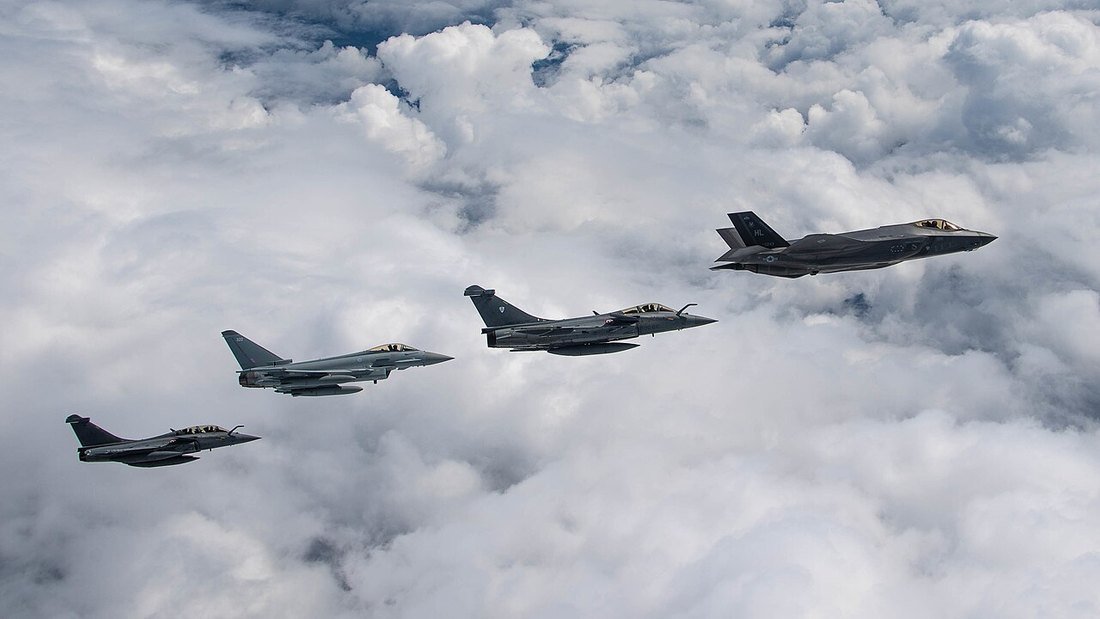
We would be writing dishonestly if we left out the strongest argument on the other side, which is that the European order books are growing at rates the Americans are not close to.
Rheinmetall’s backlog went from €56.0 billion to €80.5 billion in twelve months, on a book-to-bill the company describes as “over 3”. Saab took SEK 68.4 billion of orders in a single quarter — up 141% — for a record SEK 318 billion backlog and a 2.7x book-to-bill, including Polish submarines and Ukrainian fighters. Leonardo is running about 1.6x. Thales came in at 1.14, up from 1.01.
Against that, General Dynamics reported 1.4-to-1 and L3Harris 1.2x — good numbers, but not the same trajectory. If backlog converts to cash on schedule, the European dividends grow into their valuations and today’s yields look like a footnote in five years. That is a coherent bull case and it may well be right.
Two things temper it. First, backlog is not cash: it converts on the customer’s timetable, subject to the manufacturer’s ability to actually build the things — and Rheinmetall’s shares fell nearly 6% on its Q2 print despite record growth, on cash-flow concerns and a frigate programme setback. Second, the sector is not uniform. Dassault Aviation ran a book-to-bill of 0.69 in the first half of 2026 — its backlog shrank. One European defence company is not the same as another, and buying “the theme” through a basket buys the 0.69 alongside the 3.
Buybacks: the return nobody counts
Dividend yield understates American shareholder returns and overstates nothing in Europe, because the two markets use buybacks very differently.
Lockheed repurchased $3.0 billion of stock in FY2025 and Northrop $1.7 billion — roughly 2.3% and 2.2% of today’s market values, on top of the dividend. In Europe, BAE is running the third and final €500 million-equivalent tranche of a three-year £1.5 billion programme, and Safran bought back €804 million of stock for cancellation in the first half of 2026 alone. Rheinmetall and Saab did not repurchase a share in either 2024 or 2025 — every euro is going into capacity. Leonardo’s programme covers employee share plans rather than capital return.
One caveat that cuts against the American names: both Lockheed and RTX repurchased nothing in the first half of 2026 while continuing to pay dividends. If that pause persists, the total-return gap narrows considerably. It is worth checking before treating last year’s buyback yield as this year’s.
Boeing is the reason none of this is guaranteed
Boeing suspended its dividend on 20 March 2020, in the middle of the 737 MAX grounding and the collapse in air travel. The last payment was $2.055 a share in February 2020. As of today, more than six years later, it has still not been reinstated.
Boeing is a defence contractor with an enormous order book and a government customer that is not going away. None of that protected the dividend, because the dividend was not what protected the balance sheet. Any argument that runs “the backlog is huge, therefore the income is safe” has to explain Boeing, and generally cannot. The same reasoning applies wherever a payout is defended by a growth story rather than by cover — the tests we use are set out in our guide to dividend safety.
How we would actually hold this
Not as a choice between continents. As a split with a specific job for each half.
Defence is a capital-intensive growth story funded partly by shareholders, which makes it a cousin of the utility build-out we examined in who pays for the AI grid — in both cases the question that decides the dividend is where the money comes from, not how large the order book is.
The American primes are the income leg. Lockheed at 2.45% with a 51% payout, Northrop at 1.81% on a 31% payout, General Dynamics with a 35-year record. You are paid to wait, the cover is real, and the multiples are the lowest in the group. What you give up is growth: US budget growth is incremental, not transformational.
The European names are the growth leg, bought as growth. Size them the way you would size any 1%-yielding compounder, not the way you would size an income holding, and be honest that the dividend is a rounding error in the total return. Our guide to European defence dividend stocks works through the individual cases; the German and UK contexts are covered in our DAX dividend guide and the FTSE 100 equivalent.
Two practicalities that eat returns quietly. German dividends carry 26.375% withholding at source and French dividends 25%, against 15% for a US investor holding a US stock — reclaiming the excess is possible under treaty but slow, and our withholding tax guide sets out the rates and the process. And holding European lines cheaply matters when the yield is 1%: see our broker comparison.
What would change our mind
A European name reaching 2.5% on a payout ratio under 50% would end this argument on the spot — either through dividend growth catching up or through a price correction, and either is fine. So would two or three consecutive years of European backlog converting to free cash flow at the rate the order intake implies, since the execution risk is the real question, not the demand.
Going the other way: a sustained buyback pause at Lockheed and RTX would remove a meaningful chunk of the American total-return case. And any sign that the 2029 NATO review softens the 3.5% core commitment would hit the European names harder, because more of their valuation depends on the far end of that curve.
The one-line version
Europe is where the growth is. America is where the income is. The mistake is buying the first and expecting the second — and at 1.14%, that is a mistake a lot of income portfolios have quietly made this year.